
Introduction
Botox for men is a non-surgical treatment that relaxes targeted facial muscles to soften lines like forehead creases, frown lines, and crow’s feet. Dosing and injection placement are adjusted for stronger male muscle mass, aiming for a natural, refreshed look rather than a frozen or overly smoothed appearance.
Botox is no longer a treatment associated only with women. More men are choosing it to soften facial lines, look more refreshed, and maintain a natural appearance without making a dramatic change to their features.
Here’s the thing, though: Botox for men isn’t simply about using the same treatment approach. There are differences in facial anatomy and muscle strength can affect where Botox is injected, how much is used, and how the treatment is planned.
So, what areas can Botox treat in men? How many units you might be needed, how long do the results last, and what does treatment involve? This guide covers the key things men should know, from treatment areas and dosing to cost, safety, and natural-looking results.
This article is medically reviewed by Dr.Cengizhan Ekizceli, Board-Certified Aesthetic & Reconstructive Plastic Surgeon at Estherian Clinic.
Botox for Men: What Is It and How Does It Work?
Let’s start with the basics. Botox® is a well-known brand of botulinum toxin injections. It contains purified botulinum toxin type A, which temporarily blocks nerve signals to targeted muscles and prevents them from contracting. Sounds technical, but in simple terms, this reduced muscle activity is what softens the appearance of wrinkles and fine lines.
Your healthcare providers can inject small, precise amounts into specific muscles depending on the area being treated, and the effects are temporary, lasting several months. Botox isn’t just for wrinkles, either. According to Mayo Clinic, onabotulinumtoxinA is also used to treat conditions such as cervical dystonia (severe muscle spasms of the neck) and certain types of excessive sweating (hyperhidrosis), and it’s FDA-approved to treat chronic migraine in people who experience headaches on 15 or more days a month. So, it’s more versatile than most people realize.
Do Men Get Botox?
Yes, they do. In fact, according to the American Society of Plastic Surgeons, the number of men receiving Botox injections has steadily increased over the last decade.
For many men, the appeal is simple: soften noticeable lines without losing the facial expressions that make them look like themselves. This isn’t about changing the shape of the face or creating a completely different appearance.
What matters is how the treatment is planned. Men can have stronger facial muscles and different facial anatomy, so the areas treated and the amount of Botox used need to reflect that.
Free Quality Consult with the Doctor!
Don’t hesitate to ask your question!
What Areas Does Botox Treat?
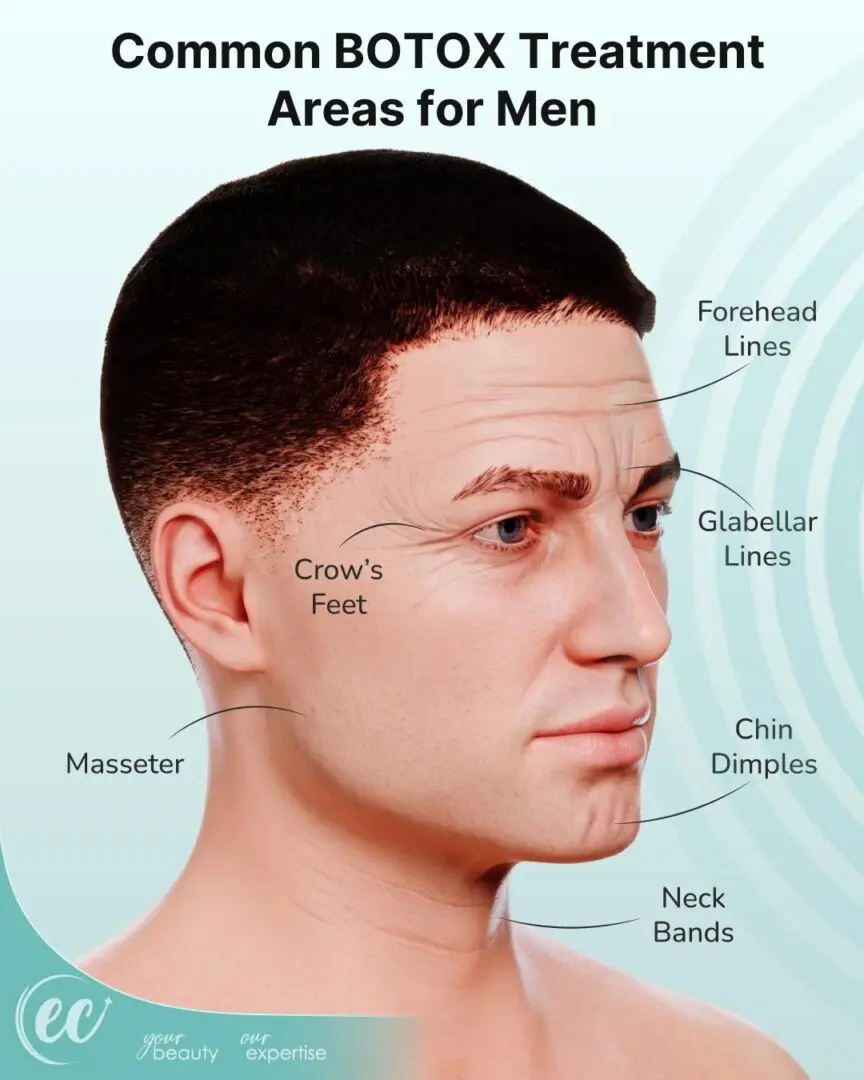
Men commonly choose Botox for areas where repeated muscle movement creates visible lines, or where stronger facial muscles affect the overall appearance. The most common treatment areas include the forehead, between the eyebrows, and around the eyes, though other areas may come into play depending on the individual’s concerns.
Forehead Lines
Horizontal forehead lines are one of the most common areas men seek Botox treatment for. Because many men have low-positioned eyebrows, treatment needs to be carefully planned to soften the lines without excessively relaxing the forehead muscles or affecting the natural position of the brows.
Frown Lines Between the Eyebrows
The vertical lines between the eyebrows, often called “11s,” can give the face a serious, stressed, or angry appearance, even when that’s not how someone actually feels. Botox can relax the muscles in this area and soften the lines while preserving natural facial expression.
Crow’s Feet
Crow’s feet are the lines that extend from the outer corners of the eyes, often becoming more noticeable with smiling and squinting. Botox can soften their appearance while keeping a genuine smile intact.
Other Uses of Botox for Men
Botox is also used for certain medical conditions, not just cosmetic concerns. For men, medically indicated uses can include treatment for excessive sweating, chronic migraines, and certain muscle spasms. These applications are separate from its use for facial lines and are worth discussing with a qualified healthcare professional when relevant.
Botox for Men Before and After: What Results Can You Expect?
So, what should you actually expect once the swelling settles? In general, the difference shows up as softer expression lines, less visible movement in the treated muscle, and an overall look that reads as more rested, not as though anything’s been “done.” Good results still let you frown, squint, and raise an eyebrow; they just soften the deep folds that used to come with it.
How noticeable the change is from one man to the next depends on several factors:
- Muscle strength in the treated area
- The number of areas treated
- The dose used
- Individual facial anatomy
- The injector’s technique
If you look at Botox on men before and after photos from real patients, rather than generic stock imagery, you can gauge what’s realistic for your own face, ideally with captions noting the treatment area and roughly how long after treatment the photo was taken.
How Is Botox for Men Different From Botox for Women?
Botox works in the same basic way for men and women, but the treatment approach may differ because facial anatomy and muscle strength are not the same for everyone. Men may have stronger facial muscles, particularly in the forehead and glabella, and that can affect how treatment is planned.
Three anatomical differences typically shape this approach:
- Thicker skin: men’s skin is generally thicker and more sebaceous, which can influence how visible lines appear and how the treated area responds
- Stronger muscle mass: facial muscles, especially in the forehead and glabella, tend to be larger and more powerful, often requiring a different dosing approach to achieve the same effect
- Lower, flatter brow position: men’s brows typically sit lower and straighter along the bony ridge, meaning injection placement must account for this to avoid over-lifting or an unnatural arch
For this reason, Botox for men shouldn’t follow a fixed male or female formula. The amount used, injection pattern, and areas treated should be adjusted to the individual’s muscle activity, facial structure, and desired result, the goal being to soften unwanted lines while preserving natural facial movement and keeping the features that make each man’s face distinctive.
How Many Units of Botox Do Men Need?
There is no single number of Botox units that applies to every man. The amount needed depends on the treatment area, muscle strength, facial anatomy, previous Botox treatment, and the degree of movement the patient wants to maintain.
Men may require different dosing from women in the same treatment areas, partly because facial muscles can be stronger and more developed. The forehead needs particular care here: since the male brow is often positioned lower, excessive relaxation of the forehead muscle can pull the brow down further, so treatment should balance sufficient muscle relaxation with the preservation of natural movement.
For the same reason, dosing around the eyes may vary according to the size and activity of the muscles in that area.
| Treatment Area | Average Unit Range (Men)* | Key Dosing Factors |
| Forehead | 20–60 units | Muscle strength, wrinkle pattern, desired movement |
| Frown lines (glabella) | 20–50 units | Glabellar muscle activity |
| Crow’s feet | 15–30 units per side | Degree of dynamic lines and muscle activity |
If you’re trying to estimate how many units of Botox for men your own treatment might involve, the honest answer is it’s hard to know without an in-person assessment, a quick consultation at Estherian is generally the fastest way to get a real number rather than a guess.
How Much Does Botox for Men Cost?
The cost of Botox for men can vary depending on the individual treatment plan. Several factors influence the final price:
- Number of units needed: more units, such as for treating multiple muscle groups, generally means a higher cost
- Number of treatment areas: combining areas (e.g., forehead, frown lines, and crow’s feet) costs more than treating a single area
- Provider’s expertise: experienced, board-certified injectors may charge differently than less specialized providers
- Location: clinic pricing varies by country and city, which is part of why medical travel for Botox has grown in popularity
- Type of neuromodulator used: Botox, Dysport, Xeomin, and other brands are priced differently and aren’t directly interchangeable unit-for-unit
Because treatment needs vary from person to person, the most accurate way to understand the expected cost is to discuss the treatment plan with a qualified provider. If you’re wondering how much is Botox for men specifically at Estherian, our team can walk you through pricing during a consultation, based on your treatment goals rather than a one-size-fits-all number.
How Long Does Botox Last for Men?
Botox does not produce permanent results. Most men begin to notice its effects within 3 to 5 days, with results typically becoming fully visible after around two weeks. The effects generally last between 3 and 6 months, after which the treated muscles gradually regain movement.
Duration varies from person to person, depending on metabolism, muscle strength, the treatment area, and the dose used. Men with stronger facial muscles, for example, may see a shorter duration in some cases. As the effects wear off, some choose repeat treatments to maintain their results.
Key Takeaway Botox typically lasts 3–6 months, but three factors can shorten this for men in particular:
- Metabolism: a faster metabolic rate can break down the toxin more quickly
- Exercise levels: men who train frequently or engage in intense physical activity may metabolize Botox faster, sometimes shortening results
- Muscle strength: larger, more active facial muscles (common in men) can cause results to fade sooner than in areas with weaker muscle activity
What Happens During a Botox Treatment for Men?
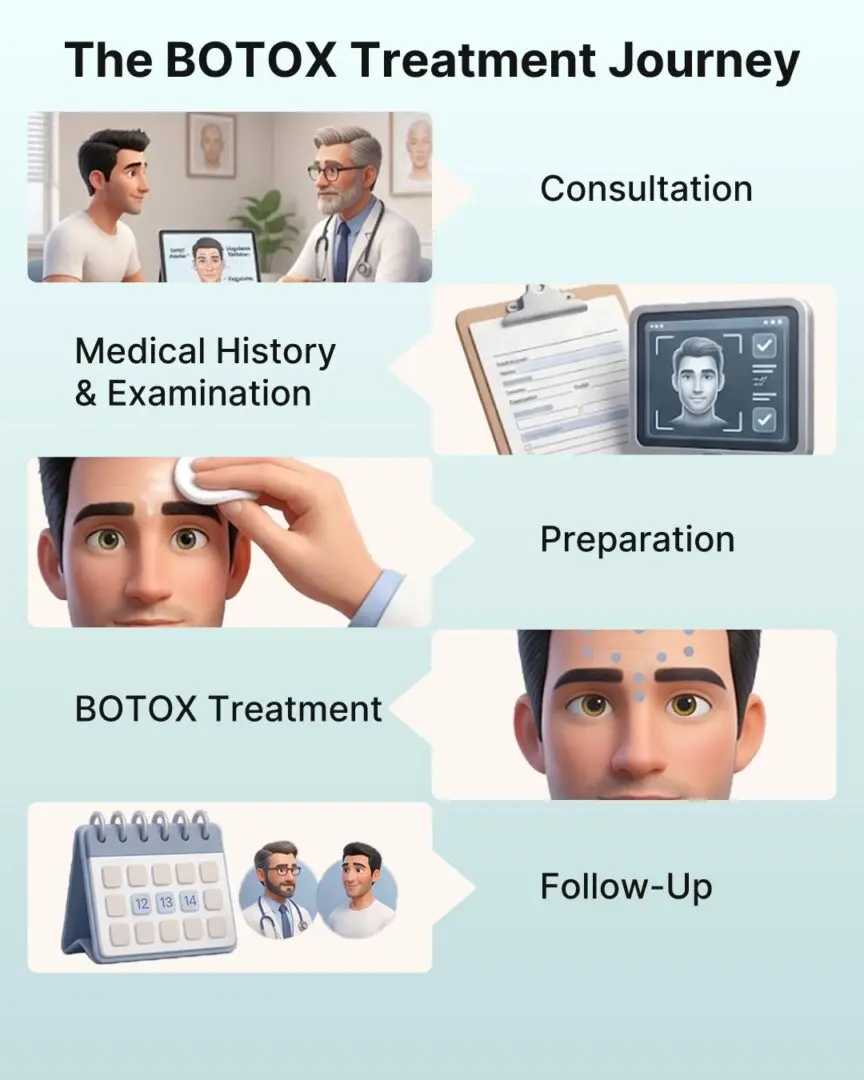
- Consultation
The appointment begins with a consultation, where your practitioner discusses your treatment goals, assesses your facial anatomy, and identifies the areas you’d like to address, helping establish realistic expectations before anything is injected. - Facial Mapping
Once you agree on a plan , the practitioner maps out the specific muscles to be treated, with placement matched to your facial anatomy and treatment goals. - Micro-Injections
Botox is injected into the selected muscles using very fine needles, with placement and amount matched to the treatment area and your anatomy. The process itself typically takes around 10 to 15 minutes. - Post-Care
Botox is minimally invasive, and patients can generally return to their usual activities right afterward, with specific aftercare instructions from their provider.
Botox Aftercare for Men
Most people return to normal activities soon after Botox, as the treatment generally requires little downtime. Mild redness, swelling, bruising, or a headache may occur around the injection sites and usually settle with time.
Do’s and Don’ts Checklist
| ✅ Do | ❌ Don’t |
| Apply a cool compress if you experience temporary discomfort | Rub or massage the treated areas for the first several hours |
| Follow your injector’s specific instructions on exercise and other activities | Assume results are immediate — changes appear gradually over the following days |
| Contact your provider if anything feels unexpected or severe | Apply skincare products directly over injection sites in a way that involves rubbing |
| Give the treatment time to settle — most people resume normal activities quickly | Ignore your injector’s individualized aftercare guidance in favor of generic advice |
Results won’t be visible immediately; changes appear gradually over the following days, and if anything feels unexpected or severe, contact your provider.
Is Botox Safe?
Yes. Botox is an FDA-approved treatment that has been used for cosmetic and medical purposes for decades. Although botulinum toxin comes from the same bacteria associated with botulism, the botulinum toxin used for treatment is purified and diluted under medical control standards approved by the U.S. Food and Drug Administration.
As with any medical procedure, safety depends on appropriate assessment, regulated products, and proper injection technique — which is why choosing a qualified professional who understands male facial anatomy matters. Most side effects are mild and temporary, such as redness or bruising at the injection site; more significant complications are uncommon, but patients should contact their provider if unexpected symptoms occur.
Who Is a Good Candidate?
Botox may be a suitable option for men who want to soften dynamic wrinkles, lines that become more visible with facial movement or expression, while keeping their appearance natural. It can be particularly useful for concerns such as forehead lines, frown lines, and crow’s feet.
Candidate Checklist
✅ Ideal Candidate
- Wants to soften dynamic wrinkles (lines that appear with facial movement or expression)
- Has concerns such as forehead lines, frown lines, or crow’s feet
- Has realistic expectations and wants a subtle, natural-looking improvement
- Is in generally good health
❌ May Not Be Suitable / Needs Further Assessment
- Has deeper, static wrinkles that remain visible even when the face is relaxed, may see more limited improvement from Botox alone
- Has certain medical conditions that can make Botox inappropriate
- Is seeking a dramatic change rather than a subtle improvement
Men with deeper, static wrinkles that remain visible even when the face is relaxed may see more limited improvement from Botox alone.
How to Get Natural-Looking Botox Results as a Man
Natural-looking Botox is less about removing every line and more about finding the right balance between softening facial lines and preserving normal expression. Treating too much, or relaxing the wrong muscles, can make the face look stiff or “frozen,” while a well-planned treatment can leave you looking refreshed without making it obvious that you’ve had anything done.
Several factors make a difference here. The appropriate muscles should be treated rather than applying the same approach to every patient, and the dose should be matched to your facial anatomy, muscle strength, and desired level of movement.
Choosing an experienced injector matters just as much. A provider familiar with male facial anatomy can assess your features and build a plan around them, rather than applying a one-size-fits-all template. If natural, refreshed results are what you’re after, booking a consultation at Estherian is a solid next step.
Do men get Botox?
Yes. Men commonly use Botox to soften forehead lines, frown lines, and crow’s feet while maintaining a natural facial appearance.
Is Botox good for men?
Botox can be a suitable option for men who want to reduce dynamic facial lines or address certain concerns such as excessive sweating. Results depend on the individual’s treatment goals and facial anatomy.
Is Botox safe for men?
Yes. Botox is an FDA-approved treatment and has been used for cosmetic and medical purposes for decades. Treatment should be performed by a qualified medical professional using appropriate technique and regulated products.
How many units of Botox do men need?
There is no standard number of units for every man. The amount depends on the treatment area, muscle strength, facial anatomy, previous treatment, and the desired level of movement.
How much does Botox cost for men?
The price varies depending on factors such as the number of units, treatment areas, provider’s expertise, location, and the type of neuromodulator used.
How long does Botox last for men?
Botox typically lasts for several months. Many men begin noticing results within a few days, with the full effect appearing around two weeks. The duration varies between individuals.
Does Botox make a man’s face look feminine?
Not necessarily. The result depends on how the treatment is planned and performed. Individualized dosing and careful treatment of the appropriate muscles can help preserve natural facial features and expression.