
A no-shave hair transplant in Turkey uses precision extraction to move follicular units without visible trimming. Procedures cost £1,850-£3,800 (60-70% below UK/US rates) while including hotel stays, airport transfers, and aftercare. So, if you are one of the people who ask, “Can I get a hair transplant without shaving my head?”, the answer is yes! Now, let’s learn more about an unshaven hair transplant, DHI, pricing, procedures, and high-quality, affordable clinics.
Considering a No-Shave Hair Transplant?
Don’t hesitate to ask your question!
This article is medically reviewed by Hilal Sağlam – Certified Hair Transplant Specialist at Estherian Clinic.
What Is an Unshaven Hair Transplant?
An unshaven hair transplant is the modern answer to the question, “Can I get a hair transplant without shaving my head?”
An unshaven hair transplant, also known as U-FUE (Unshaven Follicular Unit Extraction) or Unshaven DHI (Direct Hair Implantation), is a modern technique that allows hair transplantation without shaving your head or donor area.
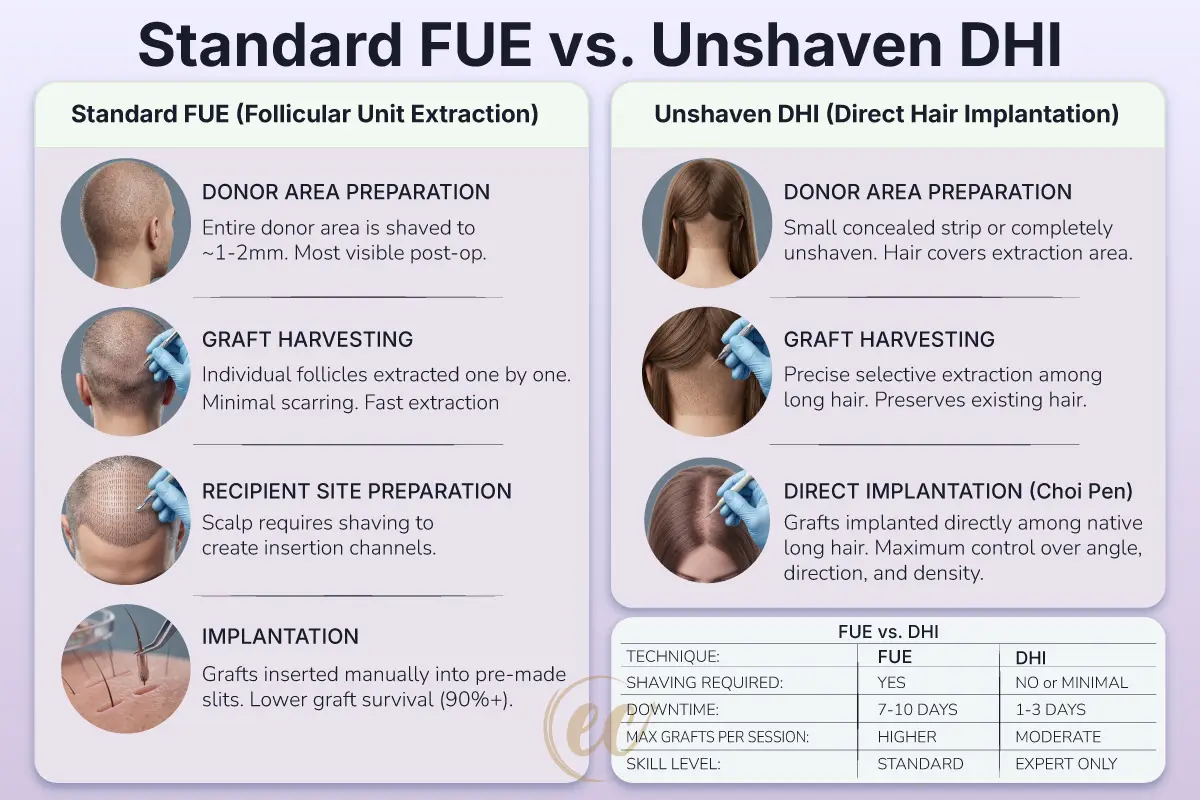
Before these modern techniques, you had to shave your scalp to 1-2 mm so the surgical team could clearly see during follicle extraction and incision creation.
However, unshaven hair transplant techniques keep your current hair length, hide surgical signs, and remove the need to buzz-cut your hair after surgery.
According to terminology published by the International Society of Hair Restoration Surgery (ISHRS), unshaven hair transplantation is categorized by whether the donor area, recipient area, or both remain untrimmed during surgery.
Is a No-Shave Hair Transplant Worth It?
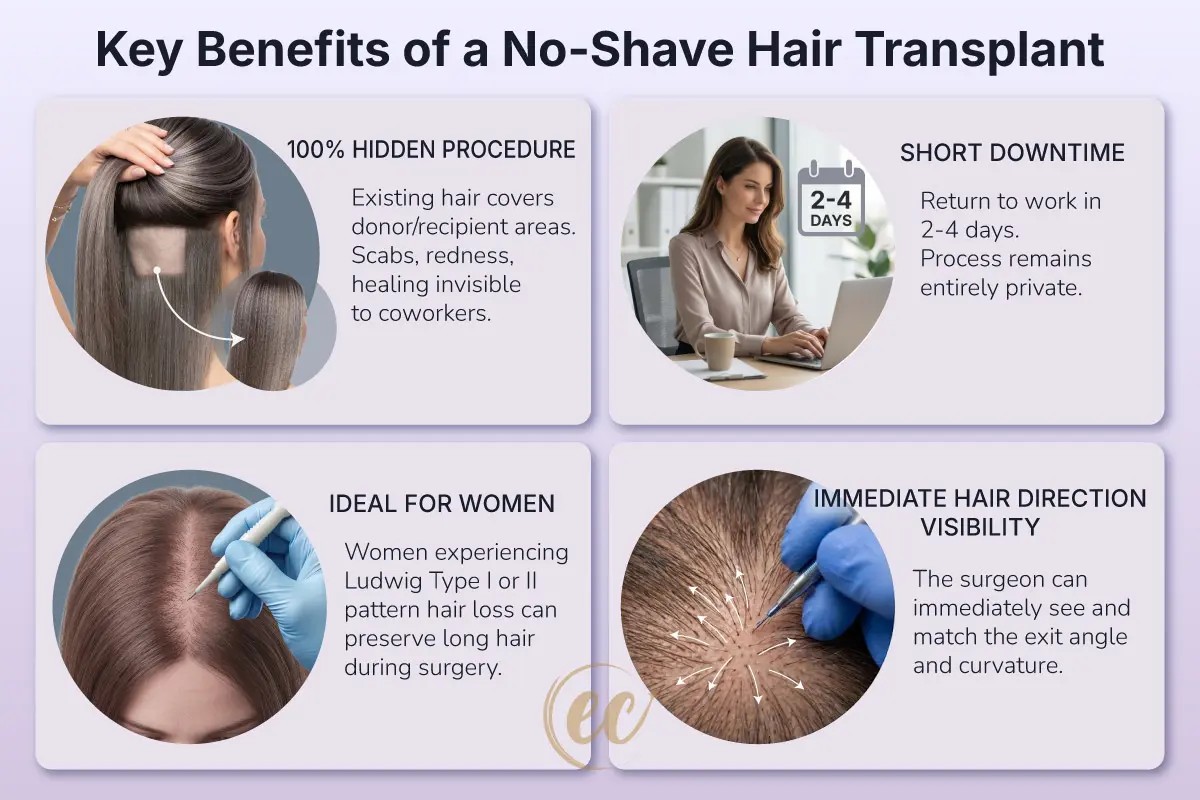
Yes, because many of those dealing with pattern hair loss or thinning spots feel nervous about shaving their whole head. But that is not the only advantage. A no-shave hair transplant:
- Has a Hidden Procedure: You can drop your existing hair over the donor area and around the recipient zone, making surgical scabs, mild redness, and healing tissue almost invisible to coworkers and friends.
- Has Short Downtime: Patients can usually return to work in 2 to 4 days, and the procedure is entirely private.
- Is Ideal for Women: Women experiencing Ludwig Type I or II pattern hair loss can preserve long hair during surgery without the distress of shaving their heads.
- Has Immediate Hair Direction Visibility: In long-hair unshaven FUE, the surgeon can immediately see and match the exit angle, curvature, and natural lay of the existing shaft as grafts are placed.
Learn More: FUE vs. DHI Hair Transplant for Women – Which Gives the Most Natural Results?
Comparing Different Types of Unshaven Hair Transplant
Now that we know the answer to the question, “Can I get a hair transplant without shaving my head?” is yes, let’s look at the different ways unshaven hair restoration can be done.
Your choice depends on your pattern of hair loss and natural hair density. Let’s go through different options.
Option 1: Partially Shaven (Hidden Donor Area)
In a partially shaven hair transplant, doctors shave a small horizontal band or window in the dense donor zone, which is usually the area at the back of the head.
The long hair around the head hangs over the shaved strip, completely hiding the extraction site.
Grafts are picked from this hidden window using a micro-motor punch (0.7 mm to 0.9 mm) and placed into the thinning recipient area without shaving the existing top or hairline hair.
Option 2: Completely Unshaven DHI (Choi Pen Technique)
Completely Unshaven DHI is the most careful hair transplant option. Neither the target area nor the donor area needs to be fully shaved. The surgeon simply trims single hairs in the donor zone right before picking them.
The picked or harvested hair roots are placed directly into a specialized tool called a Choi Implanter Pen. This tool lets the surgeon create tiny spots and place the new hair at the same time.
By sliding the needle carefully between your existing hairs, the medical team avoids damaging surrounding natural hair while controlling the direction, angle, and depth of every new hair strand in 360 degrees.
Option 3: Non-Shaven Long Hair FUE
Long Hair FUE is a specialized option in which hair roots are taken while their long hair strands are still attached. This lets you leave the surgery room with long hair and an immediate look at how full your hair will be.
You can also find various affordable offers for FUE Hair Transplantation in Turkey.
Which Is Better, DHI or FUE Hair Transplant?
To easily choose between the different types of unshaven hair transplant techniques, we can compare them side by side in the table below.
| Feature | Standard Shaven FUE | Partially Shaven U-FUE | Completely Unshaven DHI |
| Donor Area Preparation | Completely shaved | Small horizontal window shaved (hidden) | Selective micro-trimming only |
| Recipient Area Preparation | Completely shaved | Unshaven (hair left long) | Unshaven (hair left long) |
| Typical Graft Capacity | 4000-5000+ grafts | 1500-2500 grafts | 1500-2500 grafts |
| Implantation Tool | Sapphire Blade + Forceps | Sapphire Blade + Forceps | Choi Implanter Pen |
| Procedure Duration | 5-7 hours | 6-8 hours | 6-9 hours |
| Visual Downtime | 10-14 days | 3-5 days | 2-4 days |
| Technical Complexity | Standard | High | Very High |
| Relative Cost | Standard | Moderate Premium | Higher Premium |
While the technique you choose for a hair transplant affects the final results, money is also an important factor we cannot ignore. If you are looking for a more affordable unshaven hair transplant, you can choose Turkish clinics.
How Much Does an Unshaven Hair Transplant Cost in Turkey?
- Unshaven U-FUE/DHI Hair Transplant in Turkey: 2,800 – 4,500 USD
- Standard Shaven FUE in Turkey: 2,000 – 3,000 USD
- Same Unshaven Procedure in UK/US: 9,000 – 18,000 USD
Turkey is a popular destination for advanced hair transplantation, offering high surgical quality and cost efficiency.
Because Unshaven FUE and DHI hair transplants require double the clinical time, specialized single-use Choi implanter needles, and physician involvement, they can cost more than standard options.
One of the most popular Turkish clinics offering high-quality unshaven hair transplants at a much lower cost than the UK and the US is Estherian Clinic.
Why Choose Estherian Clinic for DHI Hair Transplants in Turkey?
Estherian Clinic provides all-inclusive packages for international patients. These packages cover treatment costs, 5-star hotel accommodation, VIP transfers, pre-operative blood testing, post-operative laser therapy, and medication kits.
Estherian Clinic specialists perform hair restoration under direct medical supervision and design the plans based on your hairline and goals.
The main advantages of Estherian Clinic include:
- Board-Certified Doctors: Experienced specialists, trained in advanced Choi Implanter Pen techniques and micro-harvesting, lead and perform your surgery. Their skill ensures precise control over graft angle, depth, and direction for a natural-looking hairline.
- Modern Medical Equipment: Estherian uses single-use, certified Choi implanter needles sized specifically to your natural hair follicle thickness. Customizing the needle size minimizes tissue damage, protects existing hair, and improves graft survival rates.
- All-Inclusive Packages: International patients receive special care designed to remove travel stress. Packages cover your surgery alongside 5-star hotel lodging, VIP transfers between the airport, hotel, and clinic, and multilingual medical translators for clear communication throughout your stay.
- Complete Post-Op & Medical Support: Your treatment plan includes pre-operative blood testing, post-operative laser therapy to speed up healing, and a full kit of post-care medications and special shampoos.
How Many Days of Rest Is Required After a Hair Transplant?
Healing from an unshaven hair transplant is fast and easy to hide, but you need to be a bit more careful when washing your hair around the existing strands.
Most patients return to light desk work in 2 to 3 days after surgery. Let’s go through the typical recovery timeline.
Days 1-3: Redness & Hidden Scabbing
Tiny scabs and light redness form around the new grafts. Because your surrounding hair stays long, these signs are naturally hidden under your existing strands, making the procedure very discreet.
Days 4-7: First Gentle Washes & Root Softening
You begin washing your hair at home using special lotions and mild shampoos provided by the clinic. Applying lotion softens the scabs at the roots without negatively affecting the newly placed follicles.
Day 10: Scab Shedding
As you continue gentle washes, the crusts and scabs naturally wash away under your existing hair, leaving the scalp clean and completely healed on the surface.
Months 1-3: Temporary Shock Loss
The transplanted hair shafts, and occasionally some surrounding native hairs, temporarily shed.
This is a normal reaction to the surgical process; the underlying roots remain healthy and secure beneath the skin.
Months 4-12: Permanent Growth & Full Density
New hair begins sprouting from the secure roots. Growth thickens continuously over the year, reaching full density and natural length by months 12 to 14.
What Are the Risks and Limitations of Unshaven Hair Transplant?
- Lower Graft Limits: Extracting and implanting between long, dense hair is surgically hard and time-consuming. Surgeons usually limit sessions to 2,000-2,500 hair grafts per day to keep the roots healthy outside the body.
- Risk of Temporary Shedding or Shock Loss: Your natural hair near the surgery areas may shed 2 to 6 weeks after the surgery due to scalp stress. Don’t panic because these hairs grow back fully in 3 to 4 months.
- Harder to See: Operating around full-length hair requires an expert team to avoid accidentally damaging your existing natural hair roots.
Are You a Good Candidate for a No-Shave Transplant?
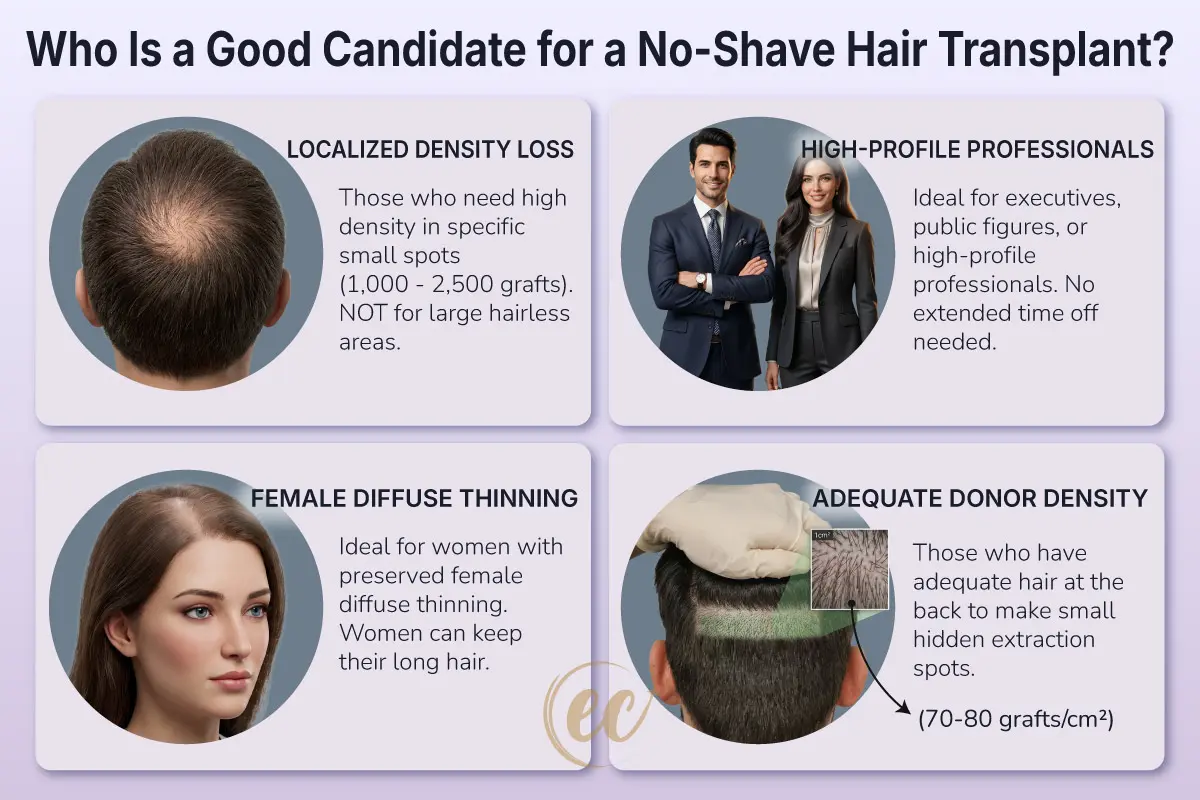
You are an ideal candidate for an unshaven hair transplant if:
- Need smaller fixes: You need light-to-moderate work (1000-2500 grafts) on your hairline, temples, or crown.
- Are a woman with thinning hair: You want to add density without cutting your long hair.
- Need total privacy: You are a professional or public figure who can’t take time off or show obvious signs of surgery.
- Have thick hair in the back: You have enough donor hair in the back of your head to easily hide the harvested spots.
Note: Patients requiring broad restoration over a completely bald scalp (Norwood Scale 5, 6, or 7 requiring 4,000+ grafts) typically require a standard shaven procedure to achieve optimal graft counts.
Not sure if your hair loss qualifies for a discrete DHI session? Contact Estherian 24/7 and send photos of your scalp via WhatsApp for an immediate, confidential medical evaluation and graft estimate.
Essential Tips after an Unshaven Hair Transplant
- Careful Washing: Long or existing hair can tangle in your scabs. Soften them by gently dabbing on special foam lotion, and never pull on your natural strands.
- No Combing: Do not comb the recipient zone for 14 days after surgery to avoid accidentally pulling out the new hair roots.
- Sleeping Position: Sleep with your head raised at a 45-degree angle using a neck pillow for 5 nights to prevent post-operative facial swelling.
Ready to Restore Your Hair with Complete Discretion?
Don’t hesitate to ask your question!
FAQs
Now that we have answered the question, “Can I get a hair transplant without shaving my head?”, let’s answer the most frequently asked questions about unshaven hair transplants.
Is an Unshaven Hair Transplant Painful?
No, the procedure is performed under local anesthesia. You can also ask for painless, needle-free anesthesia.
Can Women Get a Hair Transplant without Shaving Their Head?
Yes, women can use unshaven DHI or U-FUE procedures because female pattern hair loss usually involves diffuse thinning rather than complete baldness, allowing native long hair to cover recipient and donor zones.
Will My Existing Native Hair Fall Out after the Procedure?
Some patients experience temporary shock loss around treated areas due to micro-trauma and swelling. This shedding is temporary and resolves naturally, as your native hair regrows alongside the new grafts.
How Soon Can I Go Back to Work?
Because existing hair hides surgical scabs and mild redness, most patients return to normal office work and public activities in 2 to 4 days.