
Medically reviewed on Oct 2026 by Dr. Hilal Sağlam, Board-Certified Hair Transplant Surgeon at Estherian Clinic
Neither Sapphire FUE nor DHI is necessarily better; the right choice depends on your stage of hair loss. Sapphire FUE is the stronger choice for large bald areas and high graft counts because the surgeon can open thousands of channels quickly. DHI is the better choice for precision hairline design, filling between thinning hairs, and patients who don’t want to shave their head.
The right hair transplant method depends on how much hair you’ve lost and where. This guide explains how each works, their differences, how much they cost, and how to choose the right one for you.
What Is the Sapphire FUE Hair Transplant Technique
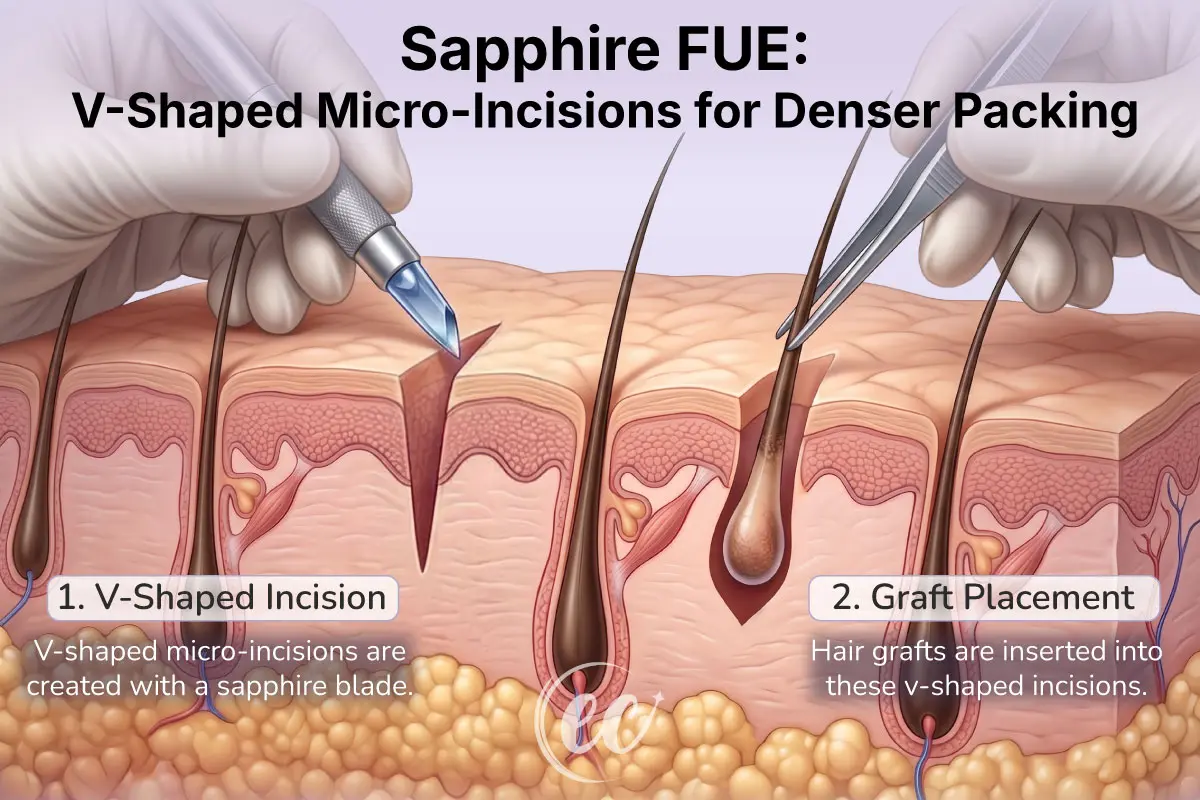
A Sapphire FUE hair transplant is an advanced method in which the surgeon uses blades made from sapphire crystal, instead of steel, to open tiny recipient channels. With their sharp V-shaped design, these gemstone blades make tiny incisions that precisely match the size of hair roots, reducing tissue damage and promoting faster healing. This is how the session works:
- First, the donor area at the back and sides of the head is shaved and numbed;
- Then, follicular units (groups of 1 to 4 hairs) are extracted with a small punch tool and kept in a cooled solution.
- After that, the surgeon opens thousands of tiny holes in the balding area with a sapphire blade, controlling the angle, depth, and direction of each one.
- Finally, the grafts are placed into those tiny holes with fine forceps.
Is Sapphire FUE Better Than Regular Steel-Blade FUE?
Yes, Sapphire FUE is medically superior to the traditional steel-blade FUE because sapphire blades enable denser hair placement and cause less trauma. Long surgical sessions cause steel blades to deteriorate, which can result in wider crusts and microtearing of scalp tissue.
Sapphire can withstand thousands of cuts because it is a very durable mineral. This offers three significant benefits to patients:
- Minimal Scalp Trauma: Smaller scabs and less post-operative swelling result from clean, sharp micro-incisions.
- Tighter Packing: Without damaging nearby skin bridges, surgeons can arrange channels closer together.
- Faster Skin Healing: The little V-shaped cuts usually close and heal within 7 to 10 days.
What Is the DHI Hair Transplant Technique?
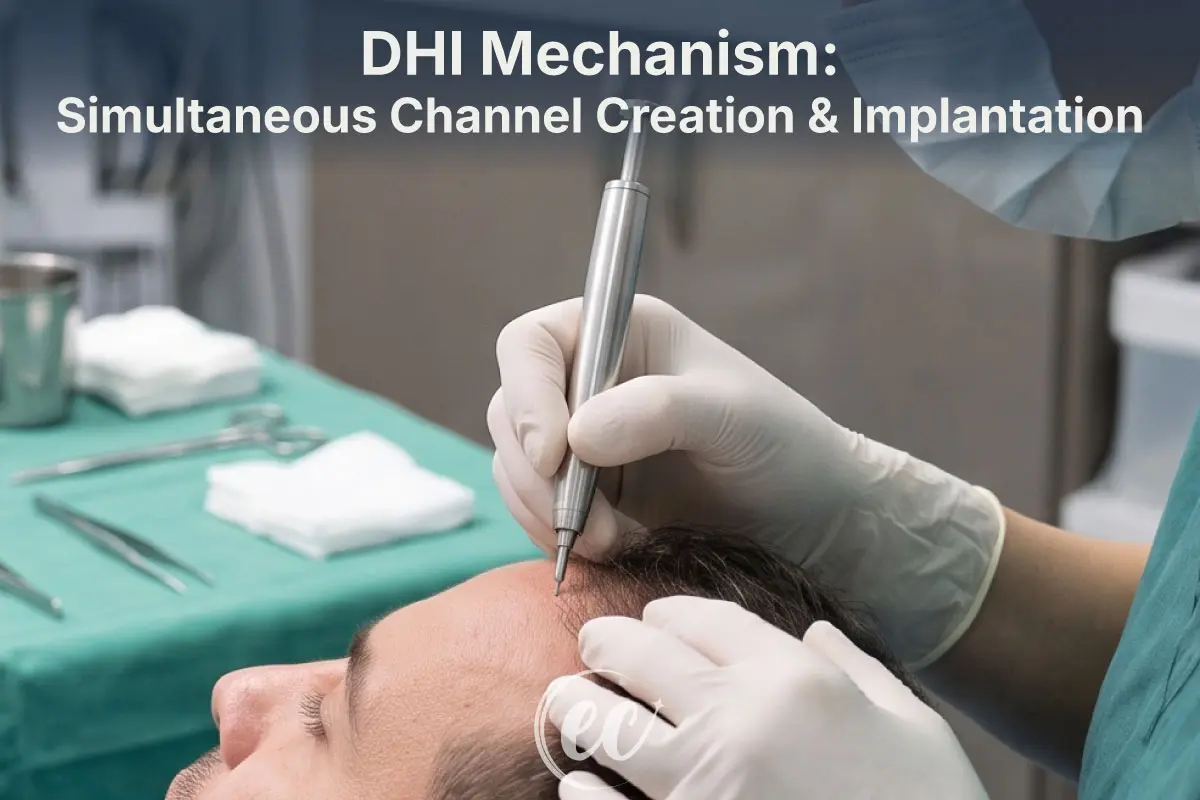
DHI (Direct Hair Implantation) is a hair transplant technique that skips the separate channel-opening step entirely. Instead of cutting slits first and then placing grafts, the graft is pre-loaded into the pen and injected directly into the scalp. The pen’s hollow needle opens the channel and deposits the graft in one motion.
The extraction process is the same as FUE. The surgeon removes follicles individually from the donor area. The difference is all in the implantation. Each graft is loaded into the pen by a technician, handed to the surgeon, and implanted. This method is slower than placing grafts into pre-made channels, but it gives the surgeon fine control over the angle and depth of every single hair.
Because the recipient area doesn’t need to be opened up ahead of time, DHI can often be done without shaving the area where hair is being added. That is crucial for someone who wants to keep their current hair long while thickening a receding hairline.
Sapphire FUE vs. DHI: What Is the Difference?
While both Sapphire FUE and DHI hair transplant techniques collect individual hair follicles from your donor area using the same extraction method, the methods used to implant those grafts into your scalp vary:
- Sapphire FUE (Two Steps): Your surgeon first uses precision V-shaped sapphire gemstone blades to open recipient channels across the treatment area. The harvested grafts are then manually placed into these prepared openings.
- DHI (One Integrated Step): Your surgeon uses a specialized Choi implanter pen that creates the channel and implants the graft at the same time. This eliminates the need for pre-opened incisions.
Quick Method Comparison
| Feature / Metric | Sapphire FUE Hair Transplant | DHI (Direct Hair Implantation) |
| Implantation Tool | V-shaped sapphire gemstone blade and micro-forceps | Hollow-needle Choi Implanter Pen |
| Surgical Process | Two-step: opens channels, then places grafts | One-step: creates a slit and places the graft simultaneously |
| Max Grafts in One Session | 3,500 to 5,500+ grafts | 2,500 to 3,500 grafts |
| Ideal Hair Loss Stage | Norwood stages* 4 to 7 (extensive baldness, crown) | Norwood stages* 2 to 3 (hairline, temples, diffuse thinning) |
| Shaving Needed? | A full scalp shave is required. | Can be performed without shaving the recipient area |
| Session Length | 6 to 8 hours | 7 to 9 hours (more labor-intensive) |
* There is a standard 7-stage system, known as the Norwood Scale, to classify the progression of male pattern hair loss.
Key Differences: Coverage, Density, and Shaving
The key differences between Sapphire FUE and DHI are about 3 main things: maximum graft capacity, hair-packing precision, and whether you want your head to be shaved. While DHI is designed for intricate sculpting between existing hair shafts, Sapphire FUE is designed to quickly cover large, bald patches.
Coverage Area and Graft Limits
Compared to DHI, Sapphire FUE manages high graft counts considerably better. If you need 4,000 to 5,000+ grafts to restore a bald crown or wide mid-scalp, creating channels with Sapphire blades is quick and efficient. DHI requires loading individual pens by hand for every single hair. This process requires mega-sessions over 3,500 grafts, which could be too lengthy to finish in a single day.
Density and Precision Between Native Hairs
DHI offers exceptional accuracy when dealing with thinning hair that already exists. The incredibly thin needle of the Choi pen moves between natural hair shafts without cutting their roots. If you have diffuse thinning rather than complete baldness, DHI allows the surgeon to add volume without damaging the hair around it.
Shaving Requirements
Sapphire FUE requires shaving the recipient area, but DHI allows for an unshaven procedure. With Sapphire FUE, your entire head must be shaved down so the doctor can accurately track thousands of tiny incisions. With DHI, only a small donor window is trimmed at the back of your head; the hair on top remains long, without obvious signs of surgery.
Cost Comparison: Sapphire FUE and DHI in Turkey
In Turkey, both Sapphire FUE and DHI hair transplant methods are 60% to 75% cheaper in Turkey than in the UK or US, typically costing $1,350–$2,000. DHI can sometimes be more expensive because the Choi pens are single-use specialized instruments, the procedure takes longer, and it requires more trained staff per graft.
| Location | Sapphire FUE | DHI |
| Turkey (Estherian Clinic, all-inclusive) | $1,350 – $2,000 | $1,350 – $2,000 |
| UK | £5,000 to £10,000 | £6,000 to £12,000 |
| US | $8,000 to $15,000 | $10,000 to $18,000 |
Both Estherian packages include the procedure, hospital or clinic facilities, hotel, VIP airport transfers, aftercare medication, and follow-up. If you are not sure which method fits your hair loss, send a few photos of your scalp (front, top, crown, and donor area) to Estherian Clinic’s medical team on WhatsApp. You’ll get a free assessment of which technique suits you and a personalized quote. Message us on WhatsApp.
Wondering which hair transplant method is right for you?
Don’t hesitate to ask your question!
Hair Transplant Recovery Timeline: What to Expect Day by Day
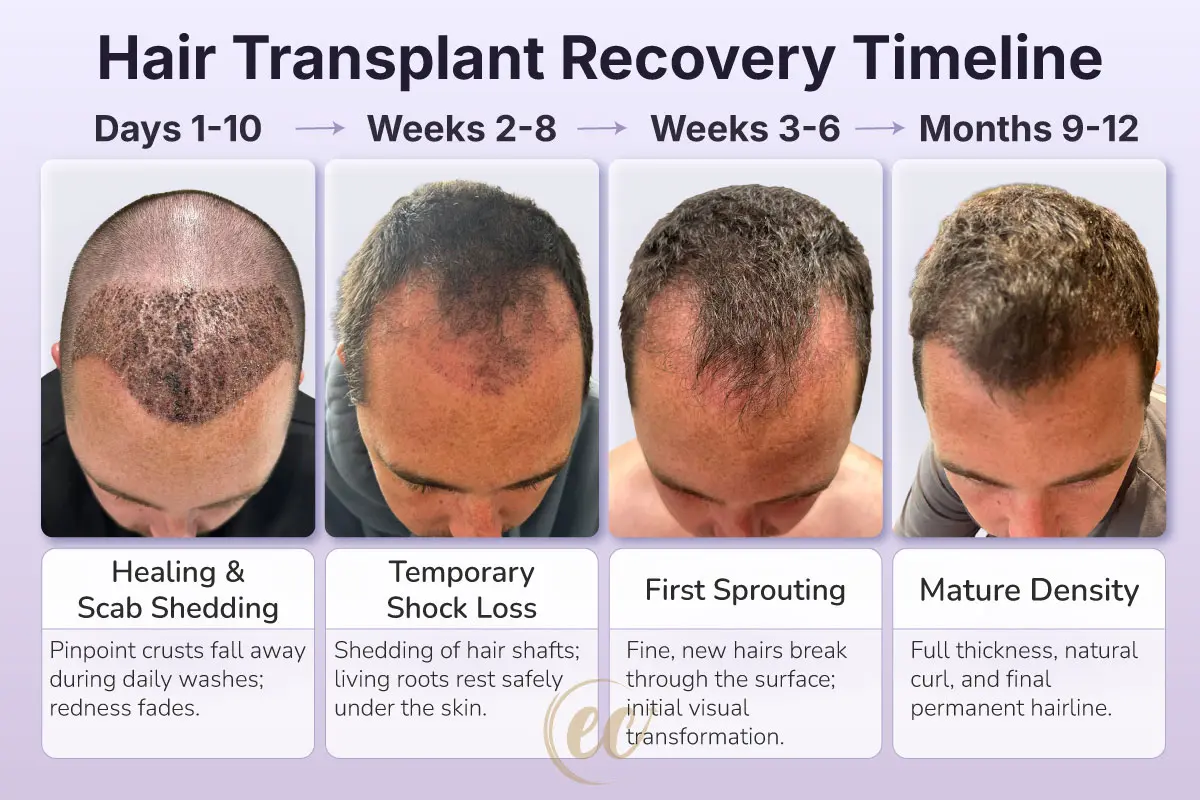
Recovery from Sapphire FUE and DHI is almost identical: both are minimally invasive and heal on the surface within 7 to 10 days. Because modern procedures never use scalpels or stitches, post-operative recovery time is substantially shorter than with older surgical methods. DHI often has slightly less bleeding and swelling on day one because no separate incision step is made; Sapphire FUE catches up within a few days. The recovery period is as follows if the procedure complies with the guidelines provided by the Society of Hair Restoration Surgery (ISHRS):
- Days 1 to 3: Mild swelling, tightness in the donor area, small scabs forming around each graft. You’ll wash gently with a prescribed spray and sleep with your head raised. Antibiotics and painkillers are standard for both methods (our guide to hair transplant drugs explains what’s mandatory and what isn’t).
- Days 4 to 10: Scabs fall off. Redness fades. Most patients fly home around days 3 to 5 and return to desk work by days 7 to 10.
- Weeks 2 to 8: Transplanted hair shafts shed in a natural phase called shock loss. The living roots stay secure beneath your skin.
- Months 3 to 6: New growth begins. Hair comes in fine and lightens before thickening.
- Months 12 to 18: Final result. Density, texture, and coverage are complete.
Aftercare is the same for both. Avoid sun, sweating, and touching the grafts for the first two weeks; skip alcohol and smoking during healing, and follow your clinic’s washing routine exactly.
Risks and Shock Loss: Real Side Effects After Hair Transplant
The general risks of both Sapphire FUE and DHI methods involve temporary shock loss, poor hair growth angles, and follicle transection if performed by inexperienced staff. A surgical tool is only as effective as the specialist handling it.
- Shock Loss: Before starting a new growth cycle, adjacent native hair may temporarily shed due to the physical impact of surgery.
- Unnatural Growth Angles: If a surgeon misaligns channel directions or angles a Choi pen poorly, new hairs can grow straight outward instead of lying flat with your natural hair pattern.
- Graft Crushing: In DHI, technicians manually insert hair roots into tiny needles. The follicle bulb may be bent or crushed by careless handling, which reduces its chances of survival.
Which Hair Transplant Method Is Best for You?
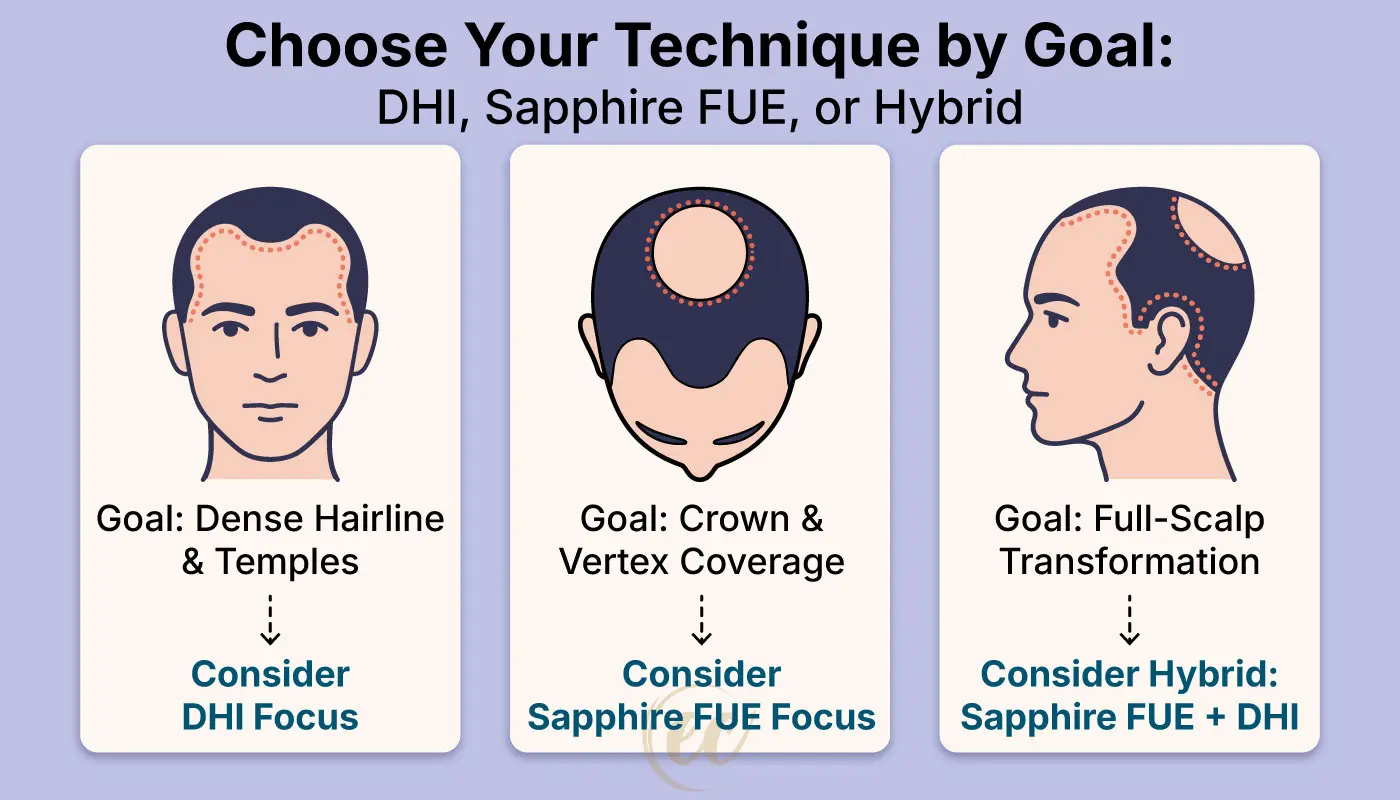
You should choose your procedure based on your Norwood balding stage and your donor hair capacity. If you need a lot of coverage, you better choose Sapphire FUE. If you need precision in a smaller area, DHI would be the ideal method. This is a simple checklist.
Choose Sapphire FUE if:
- You have advanced hair loss (Norwood 5 to 7) or a bald crown
- You need +4,000 grafts and want it done in one session
- You’re comfortable shaving your head for the procedure
- You want maximum coverage over a wide, bald surface area at an accessible price point
Choose DHI if:
- You have a receding hairline or thinning temples with healthy hair behind them
- You need fewer than 3,500 grafts
- You want to add density between existing hairs without damaging them
- You don’t want to shave the recipient area
Why Choose Estherian Clinic in Istanbul?
Estherian Clinic offers both Sapphire FUE and DHI, which means the recommendation you get is based on your hair loss, not on which equipment the clinic owns. Rather than pushing one single method, our doctors will design an individualized treatment plan for you.
- Surgeon-led assessment. A board-certified hair transplant surgeon evaluates your hair loss pattern, donor capacity, and goals before suggesting any method.
- Hybrid Approaches: For patients with a bare crown and a receding hairline, our team often performs both methods in a single session. We use Sapphire FUE for broad crown coverage and DHI for natural hairline definition.
- Complete Travel Packages: International patients receive 4- or 5-star hotel rooms, private VIP airport and clinic transfers, complete post-op medication kits, and 12 months of structured photo follow-ups.
If you need a hair transplant in Turkey, don’t hesitate to ask the Estherian team to estimate a custom surgical quote for your journey to a fresh look.
Is Sapphire FUE better than DHI?
Not generally. Sapphire FUE is better for large areas and high graft counts. DHI is better for small, precise sessions and unshaven procedures. Both give similar long-term results when done well.
Which method hurts less, sapphire Fue or DHI?
Both procedures are pretty much painless during surgery. Local anesthesia completely numbs your donor and recipient areas before any extraction or implantation starts.
Which hair transplant method gives thicker results?
Density depends on how many grafts are placed per square centimeter and how many survive, not on the method. DHI allows very precise dense packing in small areas. Sapphire FUE allows high total graft counts across large areas.
Does Sapphire FUE have a better graft survival rate than DHI?
No. Both report survival rates above 90 percent in experienced clinics. Survival depends on how grafts are handled, how long they spend outside the body, and your aftercare.
Do I need medication after either hair transplant method?
Short-term antibiotics and painkillers, yes. Long-term Finasteride or Minoxidil is optional with both and protects your native hair rather than the transplant.
Can Sapphire FUE and DHI be combined in one surgery?
Yes. This combination is known as a hybrid hair transplant. Surgeons frequently use Sapphire FUE to fill a wide, bald crown with high graft counts, and DHI to sculpt a dense, refined hairline in the front
Related Hair Transplant Procedures
- DHI Hair Transplant Turkey: Full details on the Choi pen method at Estherian Clinic
- Hair Transplant Results & Recovery Timeline: Read a case study of a hair transplant patient over a 5-month follow-up.
- Beard Transplant in Turkey: A fantastic option for men who want a fuller, natural beard.
Request Your Free Hair Analysis
Sometimes it’s difficult to decide between Sapphire FUE and DHI on your own; you’ll need expert advice. Before you book a flight, schedule a free virtual hair analysis with the surgical team at Estherian Clinic. We will tell you which method best suits your hair loss, how many grafts you need, and how much it will cost.