

Lately, public attention has turned toward singer and actress Mandy Moore. Changes in her facial contours have sparked discussions about Mandy Moore plastic surgery and whether she has undergone facial rejuvenation. Many have also wondered: if they were to achieve such a seamless, natural face without looking pulled or artificial, what surgical technique would they need? A modern technique highlighted by top facial plastic surgeons is the Deep Plane facelift. Let’s see what it is and whether it can give us a Mandy Moore face!
Want a Mandy Moore Transformation?
Don’t hesitate to ask your question!
Mandy Moore’s Facial Transformation
From her early days as a pop icon in the late 1990s to her role on This Is Us, Mandy Moore has always been adored by the public. That is why even minor changes in her appearance quickly become headlines.
Her recent public appearances have led many to ask what happened to Mandy Moore’s face and whether she has had cosmetic work done.
Many say yes to Mandy Moore plastic surgery. In recent photos, fans point to a highlighted jawline, smooth midface contours, and a lifted cheek that looks significantly youthful for a woman in her 40s.
That is why social media is filled with discussions regarding Mandy Moore plastic surgery or possible non-surgical treatments.
However, we should note that it is not all about surgery; lighting, camera lenses, professional makeup and contouring, weight loss, natural aging, and non-surgical treatments all affect how someone looks.
Because of these factors, comparing two side-by-side images can highlight differences, but it cannot definitively confirm whether someone underwent a beauty procedure.

Did Mandy Moore Have Plastic Surgery?
The short answer is that Mandy Moore has not publicly confirmed undergoing a facelift or major cosmetic surgery. She has consistently attributed her appearance to skincare, healthy lifestyle habits, and professional makeup.
And there is no reliable way to determine a specific surgical procedure from photographs alone. Even board-certified plastic surgeons emphasize that photo analysis is too speculative.
What one viewer interprets as surgical tightening might simply be high-definition contouring, special lighting, or the temporary effects of minimally invasive med-spa treatments.
When discussions arise around the question, “Did Mandy Moore have work done?”, the underlying point is not just about the celebrity’s changes but about understanding modern facial surgery approaches that can give us a smooth, fresh, and natural face like Mandy Moore.
Could a Deep Plane Facelift Create This Type of Facial Transformation?
When people ask for celebrity-level facial changes, many surgeons offer the Deep Plane facelift.
This is because older facelift methods were usually about pulling and trimming the outer layer of skin, which led to an unnaturally tight or artificial look, especially around the mouth and eyes.
In contrast, a Deep Plane facelift works beneath the surface on the structural foundation.
So, if a celebrity catches the eye with a subtle, highly defined facial rejuvenation without distortion, it could be the result of a Deep Plane facelift technique.
This method can solve different issues of the face, including:
- Midface Descent: It lifts the fallen cheek fat pads (malar fat) back to their youthful position.
- Lower-Face Sagging: It restores tightness along the jawline and eliminates marionette lines.
- Jowls: It releases tethering ligaments to completely clear jowling along the mandibular line.
- Jawline and Neck Definition: It re-establishes a sharp, elegant angle between the chin, jaw, and upper neck.
- Smoother Nasolabial Folds: It softens deep smile lines from beneath the muscle layer rather than stretching the skin over them.
But the main question is how a Deep Plane facelift can bring about these significant results, even better than previous common methods.
What Is a Deep Plane Facelift?
To answer the question, “What is a deep plane facelift?”, we need to review basic facial anatomy. The face is composed of different layers, including:
- Skin,
- Subcutaneous fat,
- A structural muscle-and-fascia layer known as the SMAS (Superficial Musculoaponeurotic System),
- Deep space planes, and
- Underlying bone structure
In a SMAS facelift, the surgeon lifts the skin away from the SMAS, tightens or folds the SMAS layer, and then pulls the skin tight. Learn more about SMAS vs. Deep Plane Facelift.
However, A Deep Plane facelift takes a different approach. Instead of separating the skin from the underlying tissue, the surgeon operates in the plane beneath the SMAS layer and above the deep facial muscles and parotid fascia.
By elevating the skin and SMAS together as a single unit, the deep plane technique can offer advantages, such as:
- Preserved Blood Supply: Because the skin remains attached to the underlying muscle layer, its micro-blood supply stays intact, improving healthy tissue healing.
- Release of Retaining Ligaments: Deep inside the cheek and jaw, there are strong fibrous anchors called facial retaining ligaments, such as the zygomatic and masseteric ligaments. A Deep Plane facelift releases these structures, allowing the tissue to glide freely into a higher, youthful position without tension.
- Tension-Free Skin Closure: Because all the lifting happens deep beneath the muscle layer, the skin is simply redraped over its new foundation. There is no pull on the incision lines around the ears, eliminating the risk of stretched scars or distorted earlobes.
To understand this procedure fully and simply, we need to dig a little bit deeper and go over the process of a Deep Plane facelift.

How Does a Deep Plane Facelift Work?
A Deep Plane facelift is a detailed surgical procedure performed under anesthesia or sedation. While each surgery is customized to each patient’s facial anatomy and needs, the procedure includes these key steps:
- Facial Assessment and Marking: The surgeon marks facial landmarks, considering nerve pathways, such as the frontal and marginal mandibular branches of the facial nerve, and key retaining ligament locations.
- Incision Placement: Incisions are made following natural anatomical contours, usually starting within or along the temporal hairline, continuing along the front curve of the ear, around the earlobe, and into the post-auricular crease behind the ear.
- Entering the Deep Plane: The surgeon elevates a small amount of subcutaneous skin near the ear before entry into the sub-SMAS plane. Delicate cuts continue beneath the SMAS across the midface and lower jaw.
- Ligament Release and Tissue Elevation: The main facial retaining ligaments (zygomatic, masseteric, and mandibular ligaments) are carefully released. This frees the midface cheek fat pad and lower face soft tissues.
- Suspension and Anchoring: The composite flap, including the SMAS and deep malar fat, is repositioned and anchored to fibrous structures near the ear and temple.
- Redraping and Closure: Excess skin is trimmed without tension. Incisions are closed using micro-sutures to minimize scar visibility.
This procedure can improve different parts of your face.
What Can a Deep Plane Facelift Improve?
A Deep Plane facelift focuses on aging in the lower two-thirds of the face. Unlike surface-level treatments, it restores both volume and position. It can:
- Restore Midface Volume: As we age, malar fat slides downward toward the mouth. A Deep Plane surgery lifts this fat pad back over the cheekbones, recreating youthful “apple” cheeks without excessive fillers.
- Eliminate Jowls: Jowls occur when descended facial fat and lax SMAS tissue spill over the jawbone. By releasing the mandibular retaining ligament, the jawline becomes soft and sharp.
- Smooth Deep Folds: Deep nasolabial folds (smile lines) and marionette lines (corner of the mouth down to the chin) are softened.
- Harmonize Lower Face to Neck: By lifting deep facial tissue, the upper neck area is smoothed, providing a harmonious look.
To better understand the outcome of this lifting technique, let’s take a look at some of the Deep Plane facelift before and after results.

Deep Plane Facelift Before and After: What Results to Expect?
When viewing Deep Plane facelift before and after results, the most notable difference compared to other facelift techniques is how unoperated patients look.
Rather than looking like a tight, pulled version of themselves, patients appear natural, refreshed, and usually 10+ years younger.
Real Deep Plane Outcomes
- Natural Facial Expressions: Because the facial muscles are repositioned rather than stretched, smiling and other facial expressions remain natural and dynamic.
- Restored Heart-Shaped Contour: In youth, the face resembles an inverted triangle or heart shape (broad at the cheeks, narrow at the jaw). Aging flips this triangle. Deep plane surgery restores the youthful inverted triangle.
- Invisible, Flat Scars: Because there is no tension on the skin edges when sutured, scars heal as fine, faint lines hidden in natural skin.
- Preserved Earlobe Shape: Traditional facelift pulling could drag the earlobe downward, creating a pixie ear deformity. Deep Plane techniques preserve natural earlobe shape.
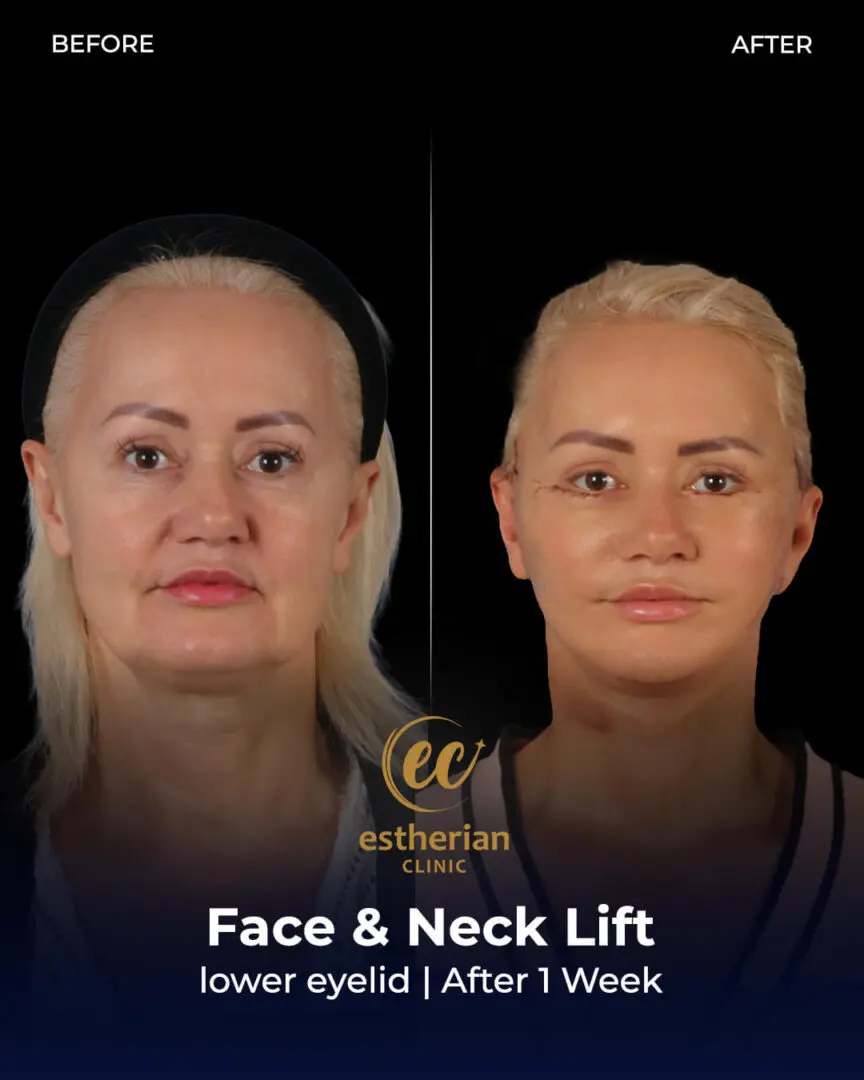
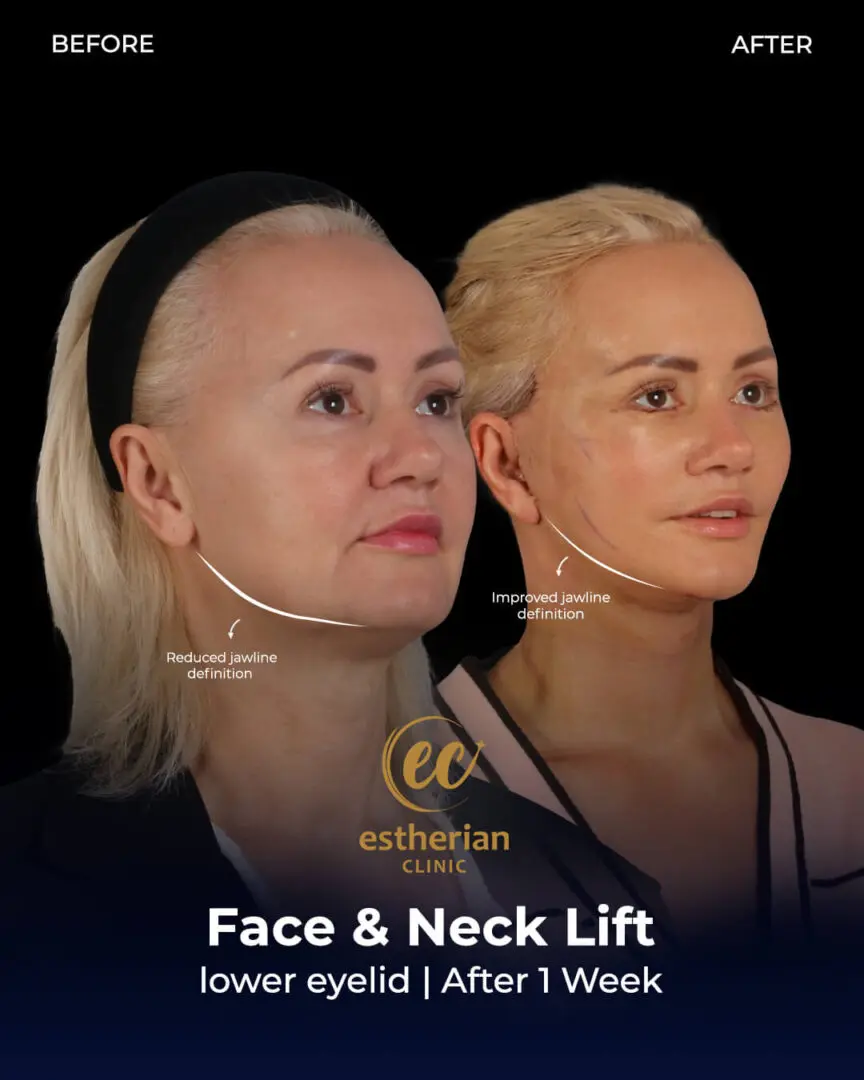
Another common facelift procedure is called a SMAS facelift. Let’s compare it to a Deep Plane facelift and find out which one can be better for you.
Deep Plane Facelift vs. SMAS Facelift
Both methods treat the SMAS layer, but they handle it differently. The table below shows the main features of a Deep Plane and a SMAS facelift. Learn more about SMAS vs. Deep Plane Facelift.
| Feature | SMAS Plication/ Excision Facelift | Deep Plane Facelift |
| Plane of Dissection | Above the SMAS layer, separating skin from muscle | Beneath the SMAS (composite skin + SMAS) |
| Retaining Ligaments | Usually left intact or partially folded | Fully released and freed |
| Midface/ Cheek Lift | Limited midface mobilization | Direct midface and cheek fat pad elevation |
| Skin Tension | Moderate skin tension required for closure | No skin tension on closure |
| Flap Vascularity | Thinner skin-only flap | Thicker composite flap with more blood flow |
| Longevity | Usually 7+ years | Usually 7+ years |
Which Technique Is Right for Me?
Neither technique is good for everybody. Surgical techniques depend on each individual’s anatomy, degree of tissue laxity, prior surgeries, and the surgeon’s decision.
While a Deep Plane facelift provides more midface release and ligament mobilization, an SMAS plication can be perfectly suitable for patients with mild skin laxity or thinner tissues.
Both of these modern techniques provide better results than traditional approaches because they result in more natural, smoother looks.
Deep Plane Facelift vs. Traditional Facelift
When comparing Deep Plane facelift vs. traditional facelift, we use “traditional” to refer to older subcutaneous skin-only facelifts developed in the mid-20th century.
Despite a Deep Plane facelift, in a traditional skin-only facelift:
- Only the skin is lifted and pulled tight.
- Underlying structural muscles are not touched.
- Results last shorter (3-5 years) because skin naturally stretches back out.
- Surgical scars are mostly wide, pulled, or noticeable.
When doing a Deep plane facelift, you may need a neck lift as well. Of course, if your surgeon recommends it.
Deep Plane Neck Lift
Facial rejuvenation is not just about the jawline. The neck and lower face form a continuous aesthetic unit. Aging in the lower face usually occurs with neck banding (platysmal bands), submental fat accumulation, and loose cervical skin.
A Deep Plane Neck Lift extends the sub-SMAS dissection down into the subplatysmal plane of the neck. During this procedure, the surgeon can:
- Release deep neck fascia and ligaments
- Address subplatysmal fat reserves beneath the neck muscle
- Tighten and suspend the platysma muscle (platysmaplasty) to eliminate vertical neck cords
- Re-establish a sharp angle between the chin and neck
Combining a Deep Plane face and neck lift can ensure that the transition from cheek to jaw to neck is smooth, seamless, and completely balanced.
Having said that, not everybody needs a neck lift. It can complement a Deep Plane facelift if your surgeon determines it is necessary.
Another factor that helps you decide if you would like to undergo a Deep Plane facelift is the number of years the results last, and you can enjoy smoother, fresher skin.
How Long Does a Deep Plane Facelift Last?
If you wonder, “How long does a deep plane facelift last?”, the short answer is that on average, results last for 10+ years.
While our biological clock keeps ticking despite facial surgery, a Deep Plane facelift is one of the longest-lasting facial rejuvenation methods available today.
Having said that, we should note that the main advantage of the deep plane lift is not necessarily duration, but its ability to mobilize the midface and cheek fat pad directly without requiring separate subcutaneous cheek dissection.
Because deep plane surgery repositions the heavy structural muscle and fat layers and releases anchoring ligaments, the foundation of the face is somehow reset to where it was a decade ago.
So, as aging continues over the following years, you age from that new, younger baseline. There are also other factors impacting longevity.
Factors Influencing Longevity
- Skin Quality and Elasticity: Collagen content and skin thickness impact long-term firmness of the skin.
- Sun Exposure: Unprotected UV exposure breaks down collagen quickly.
- Smoking: Nicotine impairs blood vessel function and accelerates skin breakdown.
- Weight Stability: Significant weight gains or losses change facial fat volume over time.
- Genetics and Bone Density: Natural facial bone resorption affects tissues over decades.
Deep Plane Facelift Recovery
Understanding deep plane facelift recovery helps you set realistic expectations for time off work and social activities.
Because the skin remains attached to its natural underlying blood vessels, Deep Plane facelifts usually cause less bruising and faster surface healing than procedures requiring skin separation.
While recovery differs from person to person and depends on personal factors, here is a general recovery timeline for a Deep Plane facelift:
Days 1-3
- You will wear a soft compression wrap around the face and jawline.
- You can expect mild to moderate swelling, tightness, and light bruising.
- Pain is usually manageable with prescribed medication.
Week 1
- Drains (if used) and initial superficial skin sutures are removed after 5 to 7 days.
- Most patients feel comfortable walking around at home.
Week 2
- Bruising fades significantly and can usually be concealed with light makeup.
- Many patients feel ready to return to desk jobs and light public events.
Weeks 3-4
- Swelling continues to decrease, especially around the cheeks and jawline.
- Mild temporary numbness near the ears is normal and gradually improves.
- You can restart normal exercise if your surgeon approves.
Months 3-6
- Final swelling resolves, revealing jawline definition and refined midface contours.
Deep Plane Facelift Complications
Any surgical procedure under anesthesia can come with complications. But working with a qualified, highly experienced facial plastic surgeon significantly minimizes the risks.
Potential risks of a Deep Plane facelift surgery include:
- Hematoma: A collection of blood beneath the skin flap can occur in 1-2% of cases. It is minimized by blood pressure control during and after surgery.
- Temporary Numbness or Hypesthesia: Numbness around the cheeks and ears is expected due to stretching of tiny sensory nerves. Full sensory recovery takes a few months.
- Facial Nerve Branch Injury: Because dissection occurs near the facial nerves, temporary weakness of nerves, such as lower lip asymmetry when smiling, occurs in under 1% of cases and usually resolves quickly. Permanent nerve injury is extremely rare in expert hands. However, transient nerve weakness (neuropraxia) or prolonged edema can occur at slightly higher rates in deeper dissections near the buccal and marginal mandibular branches compared to limited superficial procedures.
- Infection and Delayed Wound Healing: Infection rates are under 1% due to the vascularity of the deep plane composite flap.
- Scarring and Asymmetry: Slight natural side-to-side facial asymmetry is normal, though careful surgical planning ensures scars remain flat and hidden.
How Much Does a Deep Plane Facelift Cost?
Several factors affect the price you need to pay for a Deep Plane facelift. The total cost depends on:
- The expertise and reputation of the plastic surgeon
- Geographic location and surgical facility fees
- Anesthesia and perioperative care charges
- Whether complementary procedures, such as a neck lift, eyelid surgery, or fat grafting, are performed.
Because a deep plane facelift requires high technical skill and anatomical knowledge, surgical fees in Western Europe or the United States range from $15,000 to $30,000+.
However, you can achieve similar expertise at a way lower cost if you have a facelift surgery in Turkey at a reliable clinic.
For international patients seeking world-class surgical care at transparent pricing, medical tourism in Turkey has become a great choice.
At accredited centers like Estherian Clinic in Istanbul, comprehensive facelift packages combine board-certified surgical care, luxury hospital facilities, translation, and VIP transfer services at significantly lower all-inclusive rates.
| Feature | US / UK | Estherian Clinic (Turkey) |
| Cost Range | $15,000 – $30,000+ | $4,000 – $8,000 |
| Included Services | ● Usually surgical fees only ● Additional costs for facility and anesthesia | ● Board-certified surgical care ● Luxury hospital facilities ● Translation services ● VIP transfer services ● Hotel Reservations |
Deep Plane Facelift at Estherian Clinic
If you are looking for natural celebrity transformations and are researching options to refresh your appearance or achieve a Mandy Moore face, Estherian Clinic offers specialized expertise.
Located in Istanbul, Turkey, Estherian Clinic provides personalized facial assessments based on your anatomy and aesthetic goals.
Whether you require targeted lower-face contouring, a comprehensive Deep Plane face and neck lift, or complementary procedures such as Blepharoplasty or Facial Fat Grafting, Estherian’s experienced surgical team meets your needs.
Why Choose Estherian Clinic?
- Facelift surgery at Estherian costs from $4,000 to $8,000, depending on the technique used, areas treated, and the surgeon’s experience.
- Estherian includes experienced facial plastic surgeons specializing in deep plane and sub-SMAS techniques.
- Estherian clinic offers international patient care, including 5-star accommodations and personal transfers.
- Estherian provides comprehensive consultation and surgical planning focused on natural, long-lasting outcomes.
Considering Facelift Surgery in Turkey? Contact Estherian today to schedule your consultation and find out which facelift approach is right for you.
FAQs
Here are answers to the most frequently asked questions about a Deep Plane facelift.
What Is a Deep Plane Facelift?
A deep plane facelift is an advanced surgical technique in which the surgeon lifts the skin and underlying SMAS muscle layer and restores volume to the cheeks and defines the jawline naturally without pulling the skin.
Is a Deep Plane Facelift Better than a SMAS Facelift?
Neither technique is better. Choosing between them depends on your needs and your surgeon’s recommendation. A deep plane facelift offers better mobilization for midface laxity, deep nasolabial folds, and long-lasting ligament release. However, an SMAS facelift can be better for those with milder aging or specific needs.
How Long Does a Deep Plane Facelift Last?
Results usually last 7+ years. Natural aging continues, but the facial structure is reset to a younger base.
How Much Does a Deep Plane Facelift Cost?
Costs vary by region and surgeon experience. In the US and Europe, prices range from $15,000 to over $30,000. In Turkey, all-inclusive medical tourism packages at Estherian Clinic cost from $4,000 to $8,000.
What Are the Complications of a Deep Plane Facelift?
Potential risks include hematoma, temporary numbness, minor swelling, wound-healing issues, and, in rare cases, temporary facial nerve weakness.
What Is the Recovery Time after a Deep Plane Facelift?
Most patients require 10 to 14 days before returning to public activities or light work. Swelling and bruising fade significantly over 2 to 3 weeks, while final refined results appear over 3 to 6 months.
Can a Deep Plane Facelift Include the Neck?
Yes, a Deep Plane Facelift can include a neck lift if needed to address platysmal banding, submental fat, and neck skin laxity, bringing harmony across the face and jawline.
What Is the Best Age for a Deep Plane Facelift?
There is no best age, but most patients are between 45 and 65. The right timing depends on your anatomical aging and needs.
How Painful Is a Deep Plane Facelift?
Pain is usually mild to moderate and controlled with prescribed medication for the first 3 to 5 days. Patients usually report feeling uncomfortable tightness and pressure rather than sharp pain.