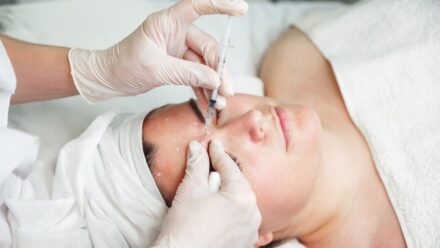

A facelift at 40 is not too early if you have visible laxity. Candidacy depends on how much your skin and deeper tissues have loosened, not on your age.
What matters is how much your skin and deeper tissues have started to loosen. At 40, most patients fall into one of three groups: early volume loss that a non-surgical liquid facelift can address, early jowls and mild neck sagging that suit a mini facelift, or more noticeable laxity where a deep plane facelift delivers the longest-lasting, most natural result. At this age, the goal is natural-looking results that preserve your facial identity without an “operated” appearance.
This guide covers the three main options for your concerns about doing a facelift in your 40s: what procedures fit you, what results to expect, and what it costs in Turkey compared to the UK or US.
Medically reviewed by Dr. Mehmet Yildiran, Board-Certified Plastic Surgeon at Estherian Clinic.
Considering a Facelift in Your 40s?
Don’t hesitate to ask your question!
Should I Get a Facelift at 40?
Yes, especially if you have visible signs of facial aging that non-surgical treatments cannot adequately address, such as sagging along the jawline, tissue descent, or loss of midface volume. However, candidacy for facial rejuvenation depends more on your facial anatomy and skin elasticity than on your age alone. Your surgeon will assess these factors to determine which procedure best suits your individual needs.
Undergoing a facelift surgery in your 40s may offer certain advantages, as skin elasticity and collagen levels are generally better preserved than in later decades. These factors can support incision healing and tissue recovery. Addressing early signs of facial aging, such as skin laxity and changes in facial contours, can help restore a more rested and refreshed appearance while maintaining natural-looking results.
Treatment Options for Facial Rejuvenation in Your 40s
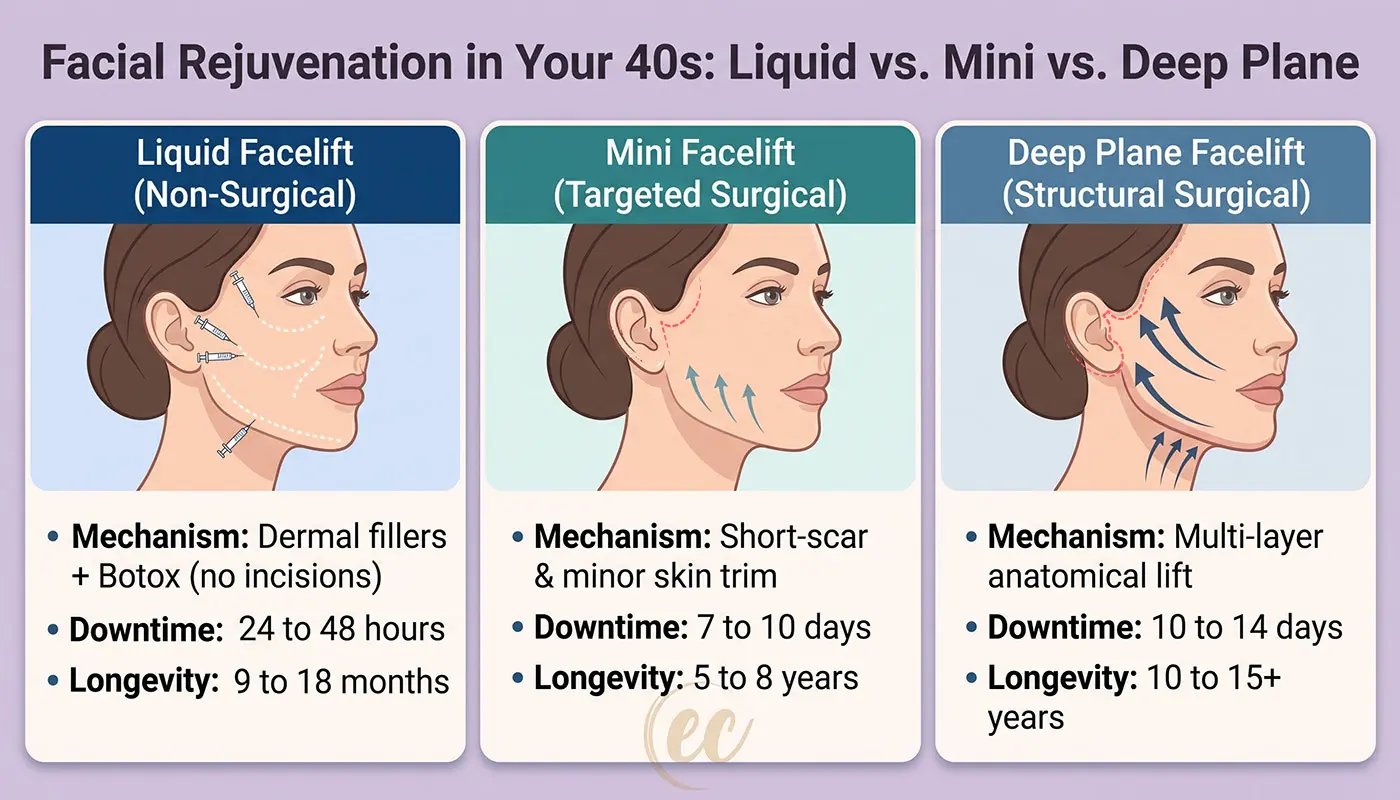
Main facial rejuvenation approaches fall into three categories: non-surgical injectables, short-scar mini-surgery, and comprehensive deep plane correction. They treat different degrees of aging, and most 40-year-olds clearly fit one of them once a surgeon has examined their face.
The degree of ligament descent or surface volume loss determines which rejuvenation technique is best for a facelift at 40.
1- Liquid facelift: the non-surgical option
A liquid facelift uses dermal fillers and Botox to restore volume and soften lines without any surgery. As explained in our article about face fat injection, your doctor injects fillers (usually hyaluronic acid) into the cheeks, temples, jawline, or under the eyes to replace volume that has thinned with age. Botox relaxes the muscles that pull the face down or cause expression lines. The whole treatment takes 30 to 60 minutes.
- Ideal for: Patients in their 40s with good skin elasticity, mild volume loss, and slight dynamic wrinkles.
- Main benefit: No surgery, minimal downtime, and results you can adjust over time.
- Limitations: Fillers add volume but cannot remove loose skin or lift sagging muscle. Overusing them to compensate for true tissue sagging can lead to a puffy, unnatural look. Results also fade, so treatments need to be repeated.
2- Mini facelift at 40: for early jowls and mild neck laxity
A mini facelift is a surgical procedure that tightens the lower face through short incisions hidden around the ear. Unlike full facelifts, the mini lift focuses specifically on correcting the early formation of jowls and sharpening a distorted jawline. Under local anesthetic with sedation, the surgeon lifts the thin muscle layer beneath the skin (the SMAS) and removes a small amount of excess skin.
- Ideal for: Patients in their early-to-mid 40s with mild-to-moderate lower-face laxity, a still-defined neck, and minimal excess neck skin.
- Main benefit: Short, discreet scars and a shorter recovery than more extensive facelifts.
- Limitations: It mainly treats the lower face, so it does not correct midface descent, deep nasolabial folds, or significant neck sagging. Results also last fewer years than a deep plane facelift.
3- Deep plane facelift at 40: structural anatomical repositioning
A deep plane facelift goes beneath the SMAS layer and releases the ligaments in the midface and jawline. This lets the surgeon lift the muscle layer and skin together as a single unit, rather than pulling only the skin. Surgery takes 3 to 5 hours under general anesthesia.
- Ideal for: Patients in their 40s with more noticeable laxity, such as midface descent, prominent nasolabial folds, or sagging mouth corners.
- Main benefit: Tension is placed on the deep ligament network instead of the skin, which avoids the “wind-tunnel” look and gives natural, long-lasting results.
- Limitations: It is the most extensive option, with a longer surgery, general anesthesia, more swelling, a longer recovery, and a higher cost.
Facial Rejuvenation Techniques at 40: At a Glance
To better understand the facelift techniques available for people aged 40 and above, the table below compares three popular options: mini facelift, liquid facelift, and deep plane facelift, highlighting their key differences in one place.
| Procedure Type | Technique Category | Primary Target Area | Recovery Downtime | Result Longevity | Benefits | Limitation |
| Liquid Facelift | Non-Surgical Injectables | Midface volume, temples, fine lines | 24 to 48 hours | 9 to 18 months | No surgery or scars, and results you can adjust gradually | Doesn’t tighten loose skin |
| Mini Facelift | Surgical (SMAS / Short-Scar) | Early jowls, lower cheeks, jawline | 7 to 10 days | 5 to 8 years | Subtle, natural refresh | Limited effect on midface and neck |
| Deep Plane Facelift | Comprehensive Surgical | Midface, nasolabial folds, jawline, neck | 10 to 14 days | 10 to 15+ years | Lifts face and neck in one surgery | Longer surgery and recovery |
Are You a Good Candidate for a Facelift at 40?
If you have noticeable structural laxity that dermal fillers, skin creams, and laser treatments are no longer able to correct, you are a good candidate for a surgical facelift at 40. While you should be in good general health and have realistic expectations, general surgical fitness and tissue quality are the critical factors. Here’s a quick checklist:
- You’ve noticed early jowls, a softer jawline, or loose skin under the chin
- Your skin still has reasonable elasticity (it springs back when gently pulled)
- You have stable general health. It means you are a non-smoker (or willing to pause nicotine well before surgery) with balanced blood pressure and no unmanaged systemic conditions.
- You want to restore the natural facial contours you had 7 to 10 years ago rather than trying to create an entirely different face.
If your concern is mainly volume and your skin is firm, you’re a liquid facelift candidate rather than a surgical one, and a good surgeon will tell you so.
Send a few photos of your face from different angles to Estherian Clinic on WhatsApp, so our expert surgeons can help you choose the best facelift option.
Facelift at 40 After Major Weight Loss
A facelift at 40 can be a good option after major weight loss, whether it came from diet, obesity surgery, or weight-loss medication. Rapid fat loss leaves the face deflated, and around 40, the skin often no longer has the elasticity to shrink back on its own; fillers alone rarely correct this.
When facial fat pads shrink, the skin and superficial muscle layer descend. This commonly leads to hollow cheeks, deeper marionette lines (the folds running from the mouth corners down toward the chin), and early jowls. These changes can make your face look older than you feel, even if your body looks healthy. In this case, surgeons usually combine a mini facelift or deep plane facelift with autologous fat grafting (transferring your own fat to the cheeks and temples). The facelift lifts and repositions the sagging tissue, while fat grafting restores the lost volume. The right combination depends on how much laxity and volume loss you have.
Note: If you are still losing weight, surgeons generally recommend waiting until your weight has been stable for a few months before surgery, so further changes don’t affect the result.
Recovery and Downtime Expectations
Recovery ranges from a day or two for a liquid facelift to about three weeks after a deep plane facelift. Surgical recovery for patients who get a facelift at 40 is typically faster than for older ages because younger skin has stronger microvascular supply and faster cellular repair cycles.
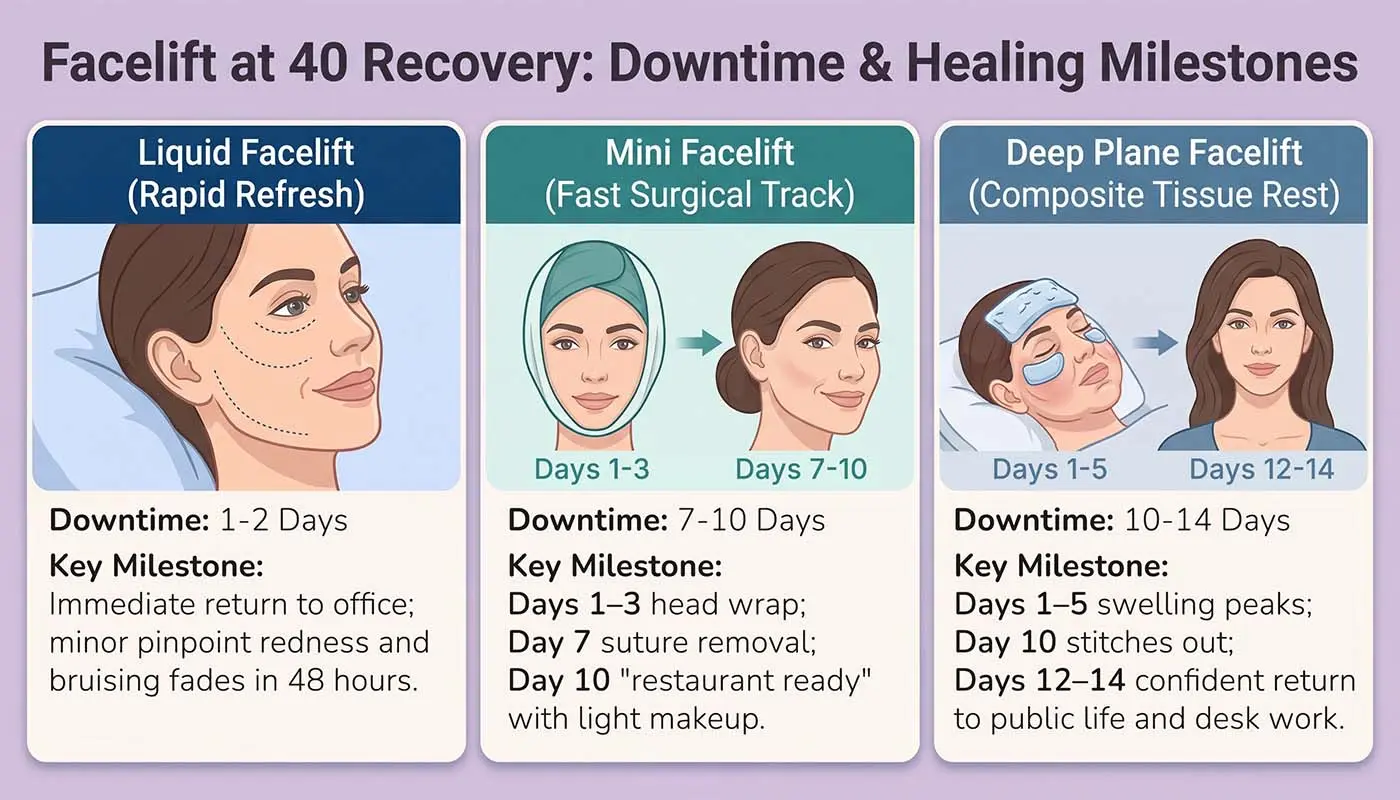
- Liquid facelift: Mild swelling and possible bruising for 1 to 3 days. Most people return to work the same day or the next. Avoid heavy exercise for 24 to 48 hours.
- Mini facelift: Swelling and bruising peak on days 2 to 3 and fade over the first week. The doctor will remove the stitches on days 5 to 7. Most patients are comfortable in public by days 7 to 10 and return to desk work in about a week. You can start exercising after 3 to 4 weeks.
- Deep plane facelift: More swelling because deeper tissue was moved. Expect to rest for the first week, be presentable by day 10 to 14, and return to work at 2 to 3 weeks. Final settling takes 3 to 6 months.
If you’re traveling to Turkey for a facelift, plan to stay in Istanbul for around 7 to 10 days after a mini facelift and 10 to 14 days after a deep plane facelift. This allows enough time for your surgeon to remove the stitches, assess your recovery, and confirm that you’re fit to fly home.
Facelift at 40: Realistic Before and After Expectations
Successful facial surgery at age 40 creates natural rejuvenation that makes your face look rested and restored rather than surgically transformed. Your friends and colleagues may obviously notice that you look revitalized, but they cannot recognize that an operation took place.
Facelift 40 typically shows a subtle change: jowls gone, jawline back, the kind of difference friends read as “you look well” rather than “what did you have done?”


Facelift Cost Comparison: Turkey vs. US & UK
A mini facelift in Turkey costs around $3,500 to $5,500 as an all-inclusive package, and a deep plane facelift is around $5,500 to $8,500. In the United States, the same procedures cost $8,000 to $14,000 for a mini facelift and $20,000 to $35,000 for a deep plane facelift. In the UK, the cost for a mini facelift is £6,500 to £11,000, while a deep plane facelift costs £15,000 to £25,000. A liquid facelift costs $800 to $1,500 in Turkey per session, compared to $2,000 to $4,500 in the US and between £1,500 and £3,500 in the UK.
| Treatment | United State | United Kingdom | Estherian Clinic (Turkey) |
| Liquid facelift (per session) | $2,000 to $4,500 | £1,500 to £3,500 | $800 to $1,500 |
| Mini facelift | $8,000 to $14,000 | £6,500 to £11,000 | $3,500 to $5,500 |
| Deep plane facelift | $20,000 to $35,000 | £15,000 to £25,000 | $5,500 to $8,500 |
At Estherian Clinic, international surgical quotes operate on an all-inclusive package model, covering the surgeon’s fees, general anesthesia, private VIP airport and clinic transfers, and all follow-up medications.
FAQs
Here are answers to the most frequently asked questions about getting a facelift at your 40s.
Am I too young for a facelift at 40?
No. Candidacy depends on how much your skin and tissues have loosened, not your age. Many surgeons prefer operating earlier, when skin is more elastic and the correction needed is smaller, because the results look more natural and last longer.
Should I get a mini facelift or a full facelift at 40?
If your changes are limited to the jawline and upper neck, a mini facelift is usually enough. If your cheeks and mid-face have also dropped, a deep plane facelift is the better choice. A surgeon can tell you in one examination.
How long does a mini facelift last compared to a liquid facelift?
A mini facelift lasts about 5 to 8 years. A liquid facelift lasts 6 to 18 months and needs repeating. Over a decade, the surgical option often costs less in total.
How long is the recovery for a liquid facelift at 40?
One to three days of mild swelling or bruising. Most people go back to work the same day or the next.
What is the difference between a mini facelift and a deep plane facelift?
A mini facelift tightens the skin and SMAS layer through small incisions and treats the lower face. A deep plane facelift goes beneath the SMAS, releases the ligaments, and moves the whole face as one unit, treating the cheeks and mid-face as well.
Can a facelift at 40 prevent future sagging?
A facelift cannot stop the biological aging process, but it resets your facial anatomy to a significantly younger baseline. Because a facelift repositions deeper tissues, your face will continue to age naturally from that refreshed starting point, giving you better definition over the following decade.
Is a liquid facelift safe?
Yes, when done by a qualified practitioner using approved products. Its side effects include minor bruising, swelling, and occasional lumps, which are temporary.
Will a facelift at 40 leave visible scars?
Plastic surgeons put the incisions in the natural creases in front of and behind the ear and along the hairline for a deep plane facelift. They fade to thin, pale lines within 6 to 12 months and are hard to see even with hair pulled back.
Related Facial Procedures
- Facelift in Turkey: A good option to regain self-confidence and achieve a healthier and more vibrant look at Estherian Clinic.
- Neck Lift Surgery: A procedure to sharpen jawlines and smooth neck bands for a balanced facial profile.
- Eyebrow lift in Turkey: A good choice to combine with a facelift at 40 for a complete refresh
Have Questions About Facelift Scheduling?
Don’t hesitate to ask your question!
Find Out Which Option Suits You
The right facelift at 40 depends on your face, not a formula. Book a free virtual consultation with Estherian Clinic’s plastic surgery team. You’ll get an honest assessment of your laxity, a recommendation among liquid, mini, and deep plane, and an all-inclusive quote for treatment in Istanbul.