
Medically reviewed by Dr. Veli Polat, Board-Certified Bariatric Specialist at Estherian Clinic
Gastric Botox is not FDA approved for weight loss. The FDA has approved botulinum toxin for several medical conditions, including chronic migraine and muscle spasm disorders. But injecting it into the stomach to treat obesity is not among the officially approved uses of Botox. The FDA has not reviewed it for this purpose, and the available evidence for meaningful weight loss shows mild and temporary results, usually lasting 4 to 6 months.
Is Gastric Botox FDA Approved for Weight Loss?
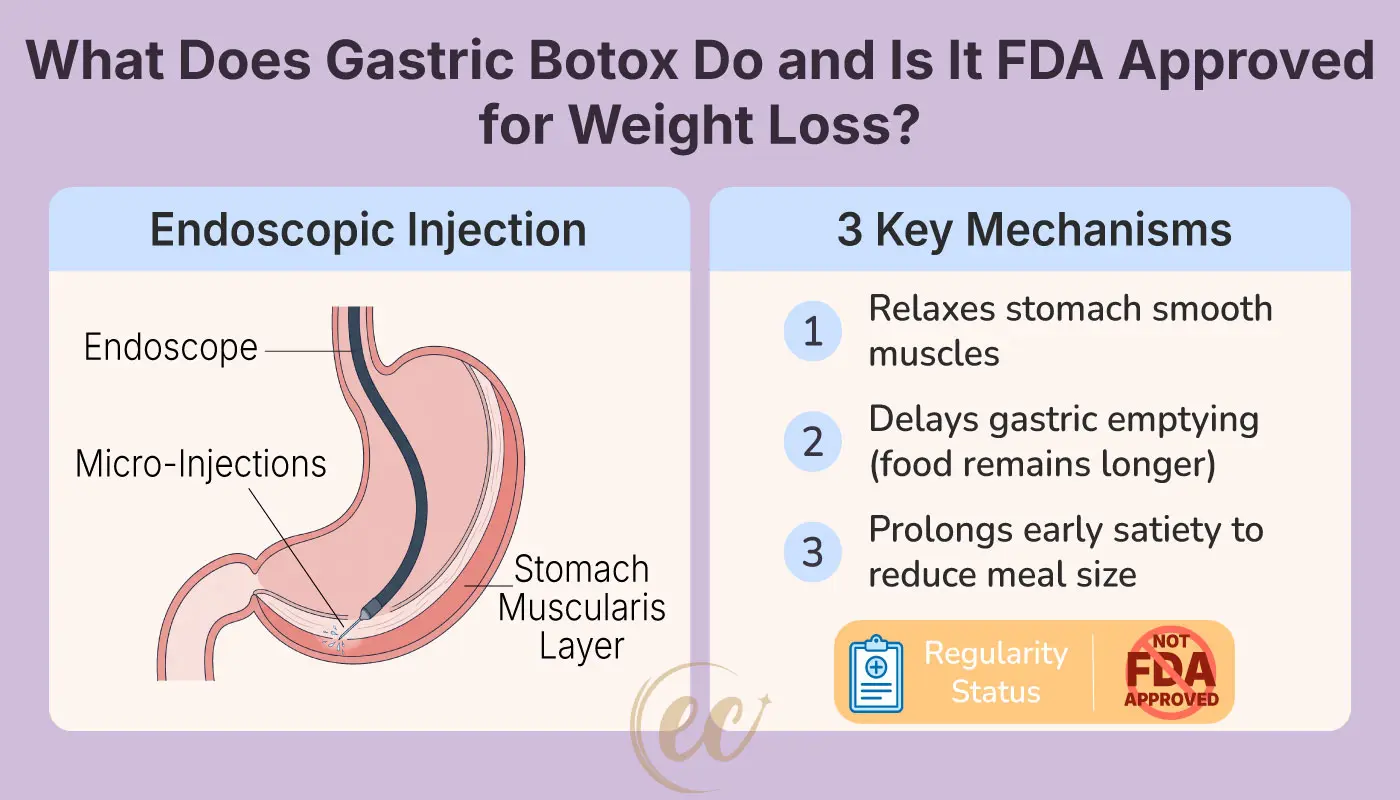
The Food and Drug Administration (FDA) in the United States has not approved gastric Botox as a treatment for weight loss. The FDA evaluates medical devices and drugs for specific intended uses. Currently, pharmaceutical companies have never received clearance to sell Botox as an obesity treatment.
The use of stomach Botox injections by physicians is off-label. It is legal and common for doctors to use drugs “off-label.” That is when a doctor who is licensed can prescribe an approved medication to treat a condition outside its official label. However, the FDA and top medical organizations, like the American Society for Gastrointestinal Endoscopy (ASGE), do not approve gastric Botox as a standard weight-loss therapy.
Quick Facts: Gastric Botox at a Glance
Before you read the full details below, here is a brief summary of the basic medical facts about gastric Botox, including how it works, how long it lasts, and its current state.
| Parameter | Clinical Fact / Detail |
| FDA Approval Status | Not approved for weight loss (strictly off-label) |
| Procedure Type | Non-surgical, outpatient endoscopic procedure |
| Primary Mechanism | Relaxes stomach wall muscles to slow down digestion |
| Duration of Effect | 4 to 6 months (temporary) |
| Average Weight Loss | 5 to 15 kg (11 to 33 lbs), depending on diet adherence |
| Anesthesia | Light intravenous sedation (twilight sleep) |
| Procedure Time | 15 to 30 minutes |
What Is Gastric Botox and How It Works?
Not sure whether gastric Botox is enough for your goals?
Don’t hesitate to ask your question!
Gastric Botox is an endoscopic procedure in which a doctor injects botulinum toxin into the muscular wall of the stomach. The term “Botox” is a registered brand name for botulinum toxin. While the term is generally used for the product, the procedure relies on botulinum toxin injections to temporarily relax stomach muscles and delay gastric emptying. With weaker contractions, the stomach empties more slowly, food stays in it longer, and you feel full sooner and for longer after eating.
The procedure itself is short, usually 15 to 30 minutes. You will receive light sedation, and a thin, flexible tube with a camera (the endoscope) goes through your mouth into your stomach. Through it, the doctor injects Botox into the lower stomach wall and sometimes across the body of the stomach. There are no cuts and no stitches.
A gastric Botox procedure doesn’t reduce the size of your stomach, change how your body absorbs calories, or alter hunger hormones in any lasting way. It only calms muscle contractions, so the food sits in your stomach longer. This helps reduce cravings in between meals.
Gastric Botox for Weight Loss vs. Gastroparesis
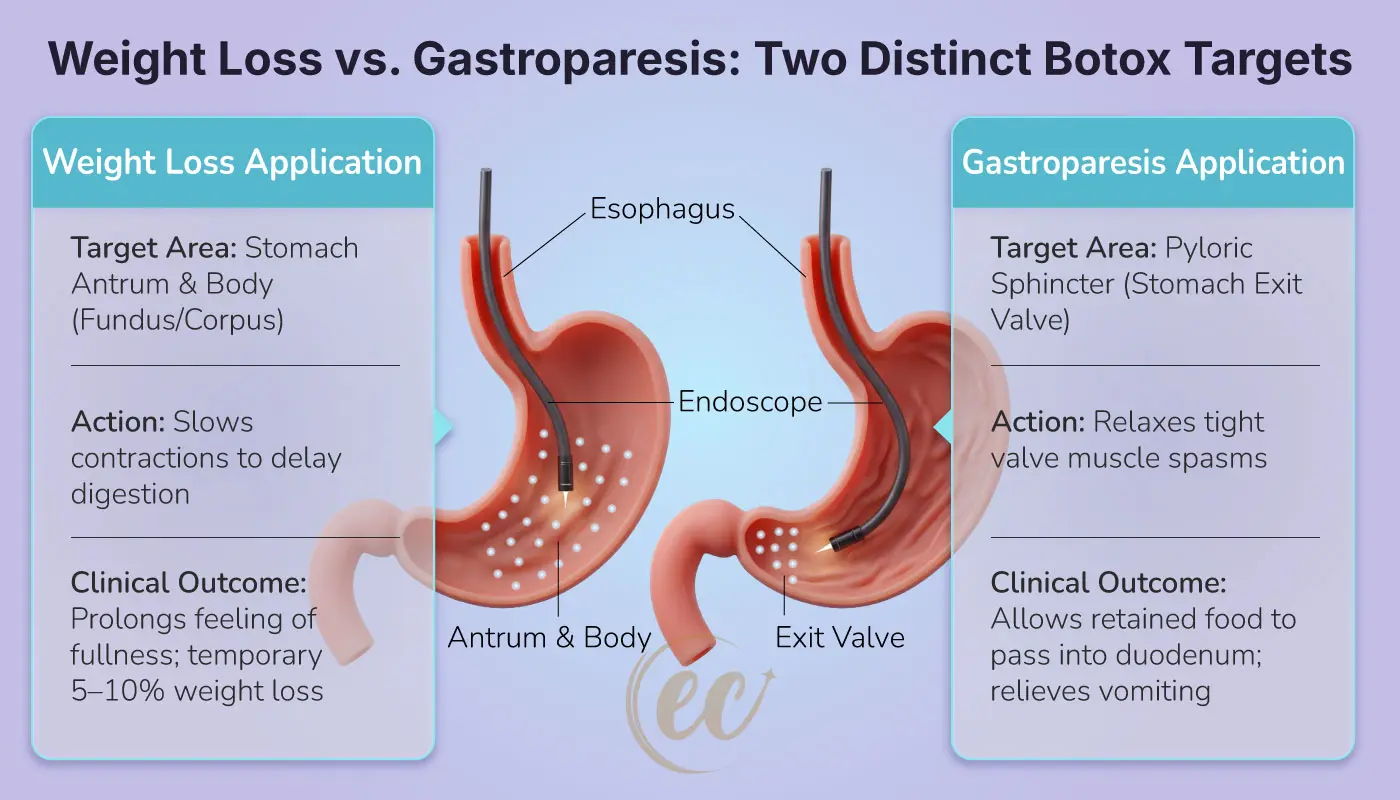
Usually, doctors use stomach Botox for two different situations: weight loss and gastroparesis, a condition where the stomach empties too slowly on its own. The two have very different objectives, target injection locations, and clinical results.
- For Weight Loss: Doctors inject Botox into the body of the stomach to slow down digestion. This will keep food in the stomach longer and prolong the feeling of fullness.
- Gastroparesis: In patients with paralyzed stomach movement, doctors inject Botox into the pyloric sphincter, the stomach’s exit valve, to help it relax and release food faster.
Results for both uses have been inconsistent in clinical research. It is important to have reasonable expectations before choosing Botox because major medical societies emphasize that it is not a permanent solution for either obesity or digestive disorders.
How Effective Is Gastric Botox for Weight Loss?
Gastric Botox produces mild, temporary weight loss, with most patients losing between 5% and 10% of their total body weight over six months. Once the Botox wears off, weight tends to return unless eating habits have changed. So you cannot expect gastric Botox to deliver the significant weight loss results seen with obesity surgeries.
Compared to other procedures, gastric Botox is a temporary boost. A gastric balloon typically produces 10 to 15 percent total body weight loss over 6 to 12 months. Gastric sleeve surgery produces 25 to 30 percent over 12 to 18 months. So, if you do not adopt sustainable, long-term nutritional and exercise habits after gastric Botox, you are likely to regain the weight once the effect fades.
Estherian Clinic’s gastroenterology team offers a BMI and health assessment to recommend the most effective option for your weight, whether that’s a non-surgical treatment or something more. Send us a message on WhatsApp.
Risks, Side Effects, and Safety Considerations of Gastric Botox
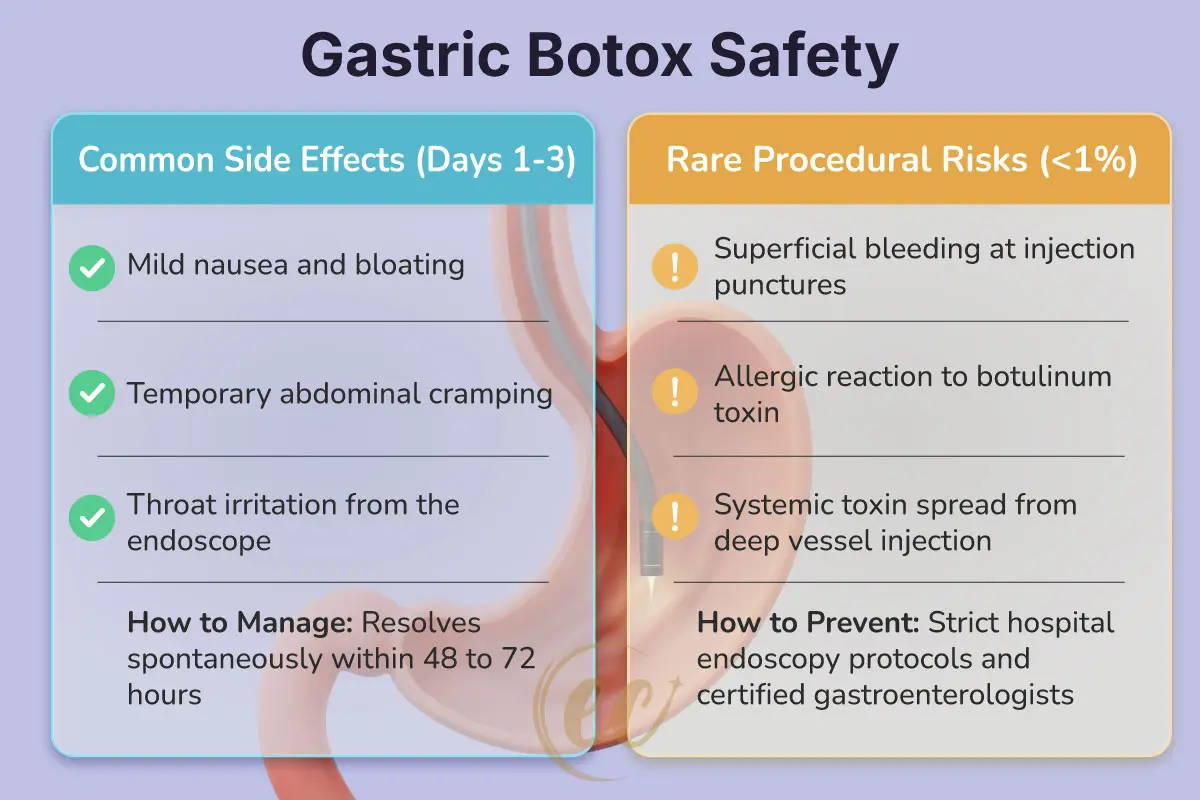
Gastric Botox is generally low risk when performed by a qualified gastroenterologist in a licensed facility. It may have some potential side effects and health risks. Most side effects are mild and usually resolve within a few days. The most common and temporary reactions include:
- Nausea or bloating, as food sits in the stomach longer
- Stomach cramps or discomfort
- Acid reflux or heartburn
- A sore throat from the endoscope
- Mild bleeding at the injection sites
Less common but more serious risks include:
- Infection or perforation of the stomach wall, which are risks of any endoscopic procedure and very rare in experienced hands
- Allergic reaction to the toxin
- If the toxin enters deep into blood vessels or spreads beyond the stomach wall, it can cause muscle weakness.
- If the stomach slows too much, the patient may experience prolonged nausea or vomiting, resulting in dehydration
Important Drug Interactions
Certain drugs that obstruct neuromuscular transmission may interact with botulinum toxin. Botulinum toxin’s effects can be amplified by aminoglycoside antibiotics (like gentamicin, amikacin, or tobramycin) and other substances that affect neuromuscular junction function, which may raise the risk of toxicity or muscle weakness. Before beginning treatment, patients must tell their doctor about all prescription, over-the-counter, and antibiotic medications.
Safety Considerations
Botox is not recommended for anyone who is pregnant or breastfeeding, has a neuromuscular disorder such as myasthenia gravis or ALS, or has a known allergy to botulinum toxin.
Most patients go home the same day and return to normal activity within 1 to 2 days. A liquid or soft diet is usually advised for the first day or two.
Gastric Botox vs. Gastric Balloon: Which Non-Surgical Option Is Better?
If you want to lose weight without surgery, the gastric balloon is the primary non-surgical choice. In contrast to Botox, several intragastric balloon systems have received official FDA approval.
| Feature / Detail | Gastric Botox Injections | Intragastric Balloon |
| FDA Status | Off-label (not approved for weight loss) | FDA Approved (brands like Orbera and Spatz3) |
| How It Works | Relaxes stomach muscles via injections | Takes up physical space inside the stomach |
| Average Weight Loss | 5% – 10% of total body weight | 10%–15%+ of total body weight |
| Duration | Lasts 4 to 6 months (gradually wears off) | Remains in place for 4 to 12 months |
| Reversibility | Cannot be reversed; wears off naturally | Can be deflated/removed early if needed |
| Ideal Candidate | Mild weight loss needed (BMI 27–32) | Moderate weight loss needed (BMI 27–35+) |
For most patients considering a non-surgical option, the balloon is the better treatment backed by clinical trials and regulatory approvals. If your BMI is above 35 or you have weight-related health conditions, neither may be enough, and a surgical option like gastric sleeve surgery becomes the realistic path.
Read more: The Complete Guide to Gastric Sleeve Surgery
Who Is a Good Candidate for Gastric Botox?
Gastric Botox is generally considered only for mildly overweight people with a BMI between about 27 and 35 who want a short-term aid while making dietary changes. It is not a treatment for significant obesity. You may be a good candidate if:
- Your Body Mass Index (BMI) is between 27 and 32
- You need a short-term tool to help control hunger while building healthier eating habits.
- You’ve decided to follow a reduced-calorie diet during the 4 to 6 months the Botox is active
- You’ve been assessed by a gastroenterologist, and other causes of weight gain have been ruled out
You should avoid it if:
- You have a neuromuscular condition such as myasthenia gravis, Lambert-Eaton syndrome, or ALS
- You have had previous stomach or bariatric procedures (such as a gastric sleeve, gastric bypass, or significant stomach resection)
- You are pregnant or breastfeeding
- You have a known allergy to botulinum toxin or any of its ingredients
- You have gastroparesis or another condition that already slows your stomach
- You have a stomach ulcer, active infection, or bleeding disorder
- You have a BMI above 35 and are looking for a substantial result
Honest advice from a clinic should include telling you when gastric Botox is not the right choice after examining your body and health situation. You can consult the bariatric team at Estherian Clinic and seek their professional advice to determine which option is best for your weight loss problems.
Is gastric Botox safe?
When done by a certified gastroenterologist in a licensed facility, it is generally low risk. Nausea, bloating, and cramps are common side effects that are mild and transient. Serious complications are rare.
What are the potential side effects of gastric Botox?
Nausea, bloating, stomach cramps, acid reflux, sore throat, and minor bleeding at injection sites are the most common. Rare risks include infection, perforation, allergic reaction, and very rarely, the spread of the toxin beyond the stomach.
How long does it take to recover from gastric Botox injections?
Most patients go home the same day and return to normal activity within 1 to 2 days. A soft or liquid diet is usually recommended for the first 24 to 48 hours.
How long does gastric Botox last?
The effect typically lasts 4 to 6 months. After that, stomach function returns to normal, and any weight lost may return unless the diet has changed.
How much does gastric Botox cost in Turkey?
Gastric Botox in Turkey generally costs between $1,000 and $2,500, compared to $3,000 to $5,000 in the US or UK. Prices vary with the clinic and the dosage used.
Is gastric Botox better than a gastric balloon?
No procedure is “better” than another; they serve different patient profiles and goals. Gastric Botox may be better if you have a lower BMI (typically 27–30) and want a subtle appetite-suppression boost to help build healthier dietary habits. Gastric balloons are better if you prefer a higher weight loss and need stronger physical hunger cues to limit portion sizes.
Related weight loss procedures
- Gastric Balloon Turkey: The FDA-approved non-surgical alternative, with 10 to 15 percent average weight loss
- Weight Loss Surgery in Turkey: An overview of surgical options for higher BMI patients
- Gastric Sleeve Turkey: the most common permanent bariatric procedure
Find the Safest Weight Loss Option for Your Body
Gastric Botox is a mild, temporary treatment that suits a small group of patients. There are other nonsurgical and surgical procedures to meet the weight loss objectives of people with different BMIs. Contact Estherian Clinic today to discuss your BMI, review your medical history with our gastroenterology specialists, and find a safe, effective path to reaching your target weight. Book a free consultation to find the safest, most effective path for you.